


How AI Detectors Actually Work: A Technical Deep Dive (Non-Jargon)

With generative language models entering the content creation space through tools like ChatGPT and Claude, an entire industry of AI content detectors has emerged to monitor them: GPTZero technology and Turnitin AI detection now scan student essays, content submissions for publishers, and even SEO content for businesses.
But what actually goes on inside AI detection algorithms? Does a detection tool examine digital watermarks, compare against an online database of AI text, or does an AI "read" the content like a human proofreader would?
By analyzing the inner workings of AI detection software, we can better understand how these tools work and why they sometimes return false positive results.
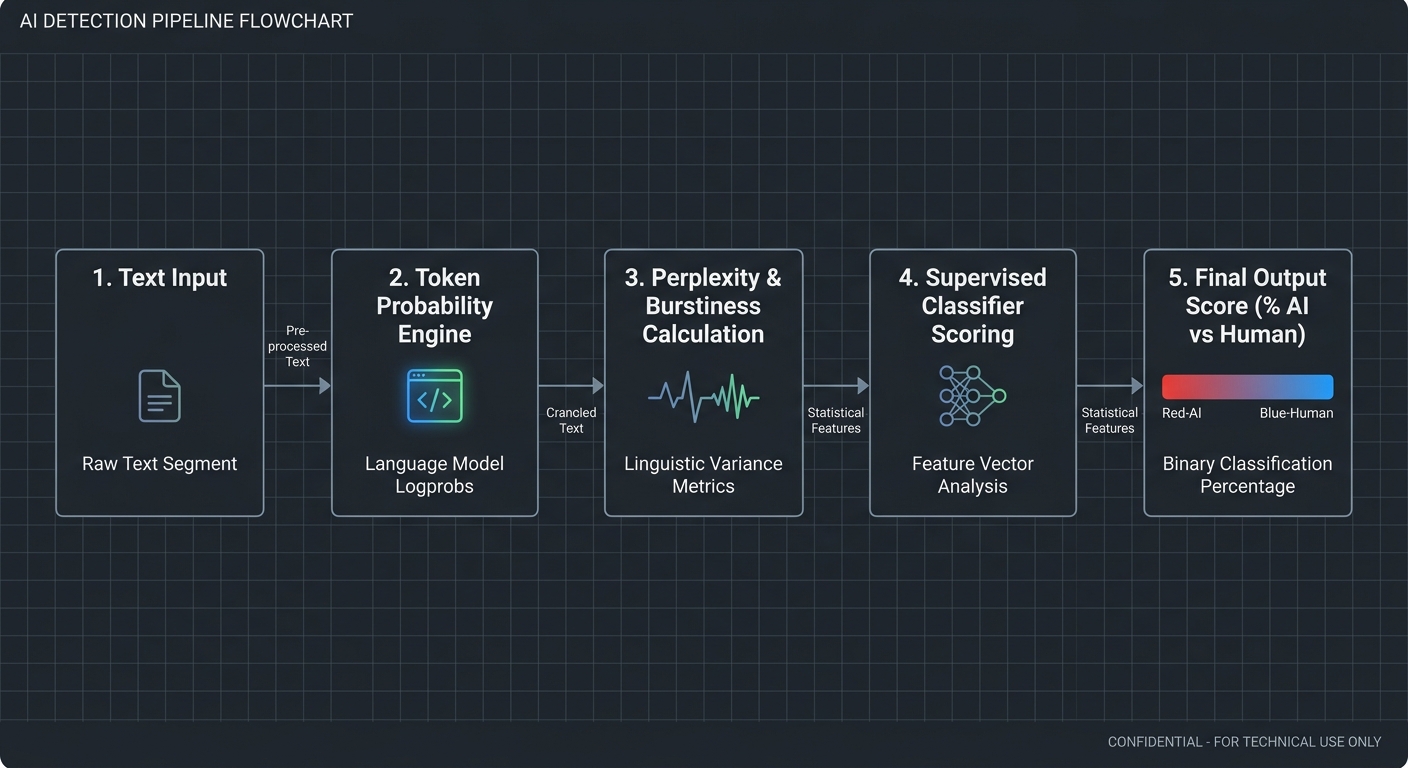
What a Detection System Is Actually Measuring
AI text humanizer do not examine the source text or look for hidden code tags in the body of the writing. Instead, an AI detection algorithm analyzes a text passage using another language model to determine how "predictable" the text is.
Large language models (LLMs) generate text by choosing the most statistically likely word at every position in a sentence. Since these tools always select the "highest probability choice," the resulting text will always have a characteristic mathematical pattern. Detectors then analyze the text using this mathematical fingerprint.
Core Principles: Perplexity and Burstiness Explained
The two main statistical concepts used by modern AI text humanizer are perplexity and burstiness.
1. Perplexity (Word Predictability)
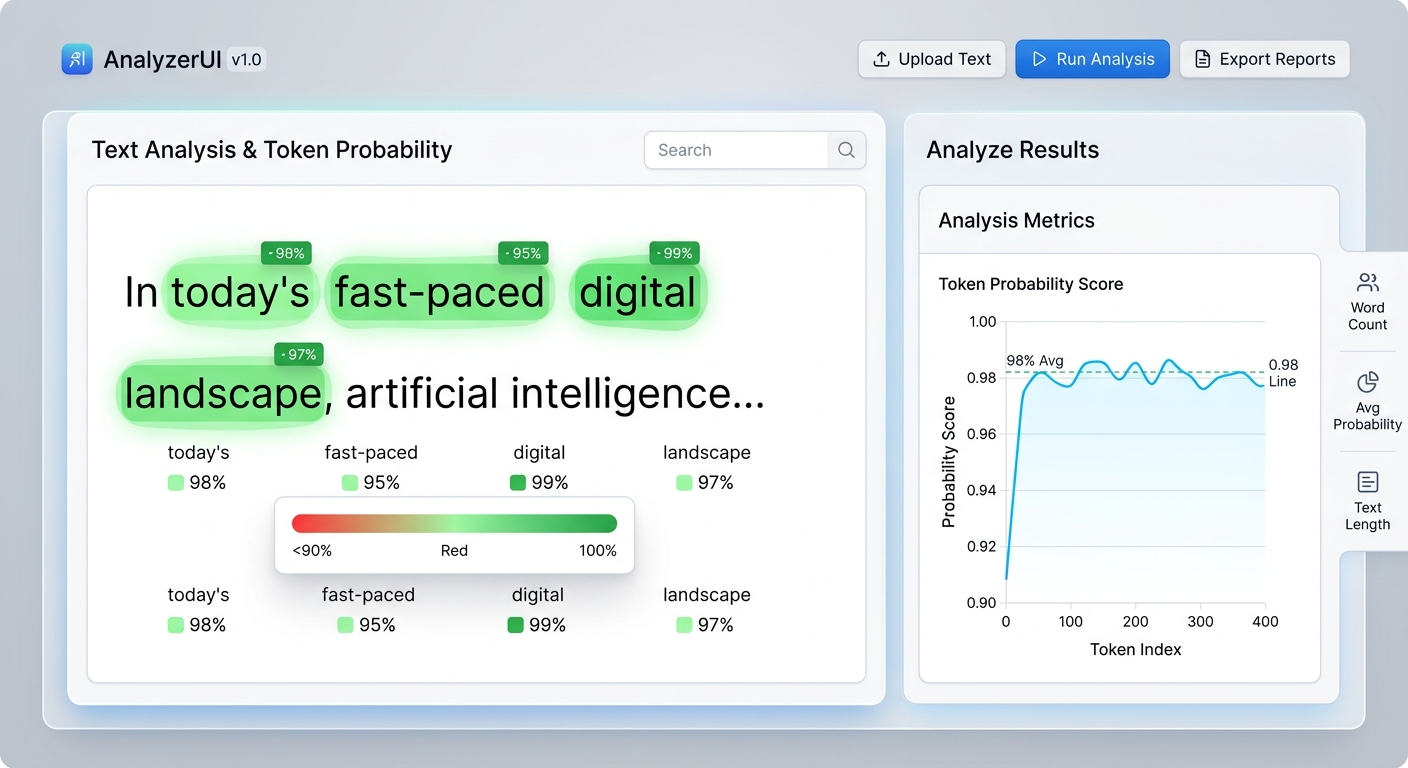
Perplexity refers to how "surprised" a language model is by the text it reads. When an AI detector scans a passage, it looks at the token probability – the mathematical prediction of what word comes next based on context.
- Low Perplexity (Machine-like): The text has higher probabilities of specific word choices that follow certain contexts. If I write "In today's fast-paced...", the AI expects the next word to be "world" or "digital landscape."
- High Perplexity (Human-like): The text uses surprising language patterns, analogies, and non sequitur word associations that defy token probability.
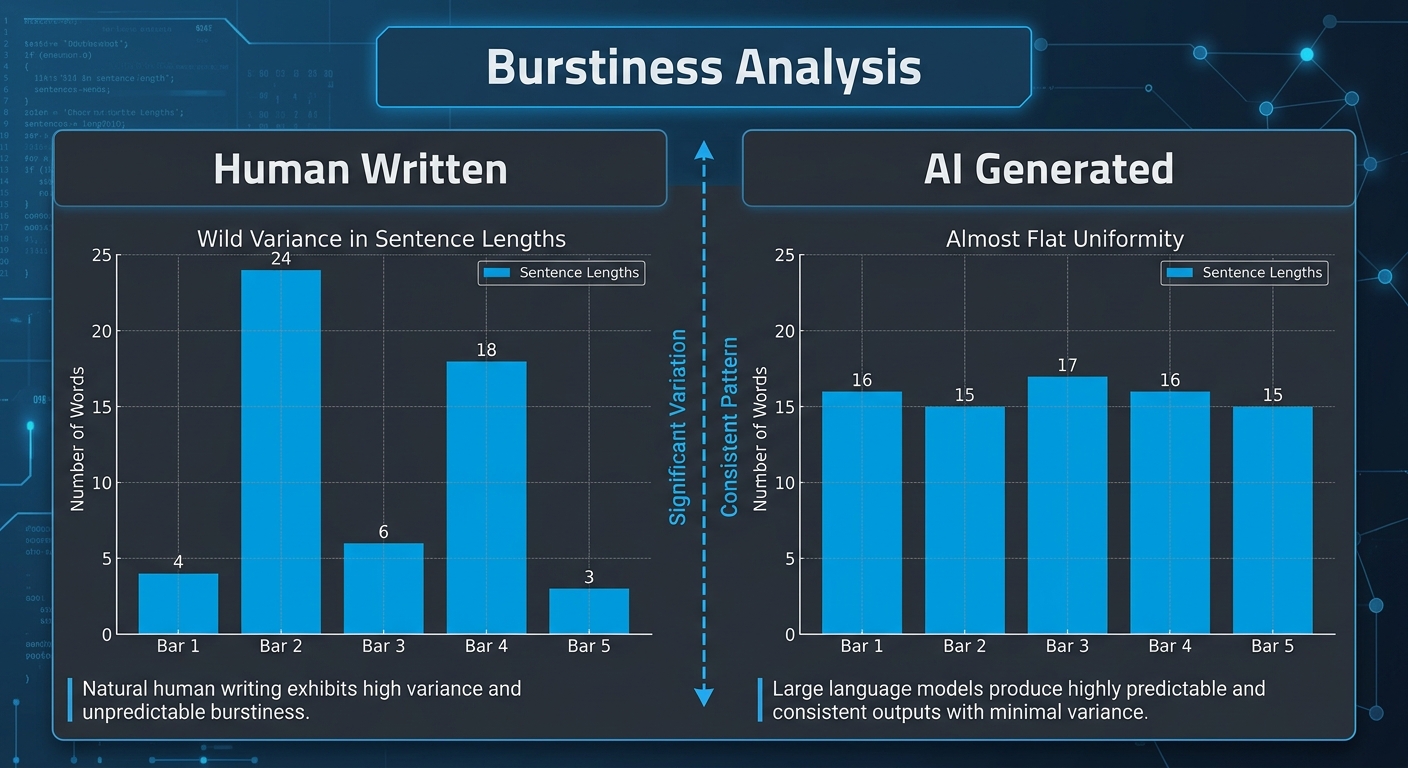
2. Burstiness (Rhythm and Variance)
While perplexity measures the statistical likelihood of specific word choices, burstiness refers to the variance in sentence structure within a text.
HUMAN RHYTHM (High Burstiness)
- Sentence 1: Short punchy claim. (4 words)
- Sentence 2: A much longer, complex explanatory sentence featuring clauses and detailed context. (14 words)
- Sentence 3: Medium length observation. (5 words)
AI RHYTHM (Low Burstiness)
- Sentence 1: Standard uniform structure sentence. (5 words)
- Sentence 2: Another balanced sentence rhythm. (4 words)
- Sentence 3: Similar length sentence output. (4 words)
Humans tend to alternate sentence structure length, varying between short (4-7 words) and long complex sentences (15-20+ words). Generative AI produces low burstiness writing with uniform sentence length distribution, averaging between 15-20 words per sentence. Low variance in sentence structure equals low burstiness, indicating potential AI authorship.
Statistical Detection vs. Classifier Models
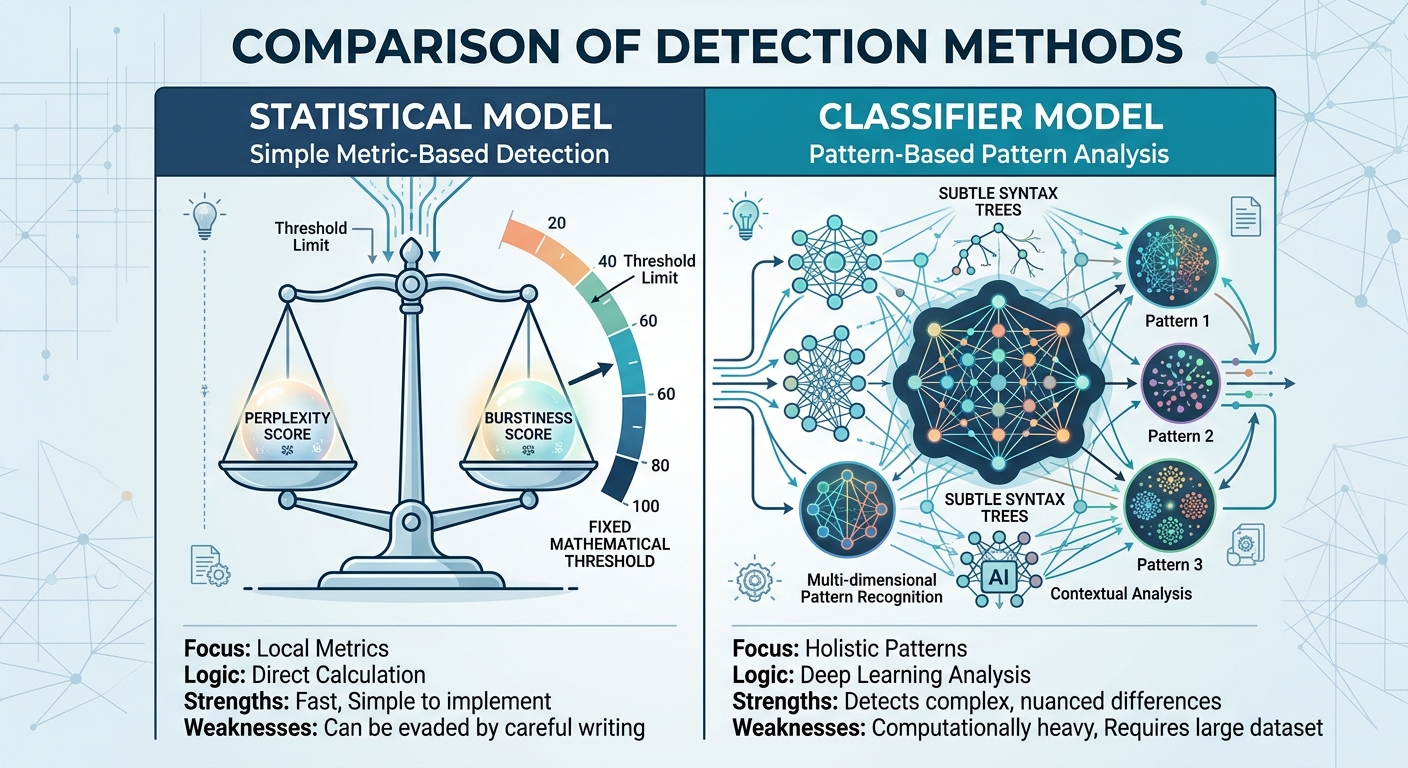
Most AI detection software uses one of two approaches – or a combination of both – to determine if content was created by an AI:
| Detection Method | Mechanics | Primary Strength | Weakness |
|---|---|---|---|
| Statistical Analysis | Evaluates explicit perplexity and burstiness metrics across text samples. | Fast, model-agnostic, clear mathematical thresholds. | Easily altered by simple manual editing or paraphrasing. |
| Classifier Model AI Text | A supervised classifier model AI text trained on millions of human and synthetic content samples. | Identifies subtle structural patterns, tone shifts, and syntax distributions. | Requires constant retraining as new LLMs are released. |
Tools like Turnitin AI detection use trained classifier models against academic writing repositories, while GPTZero technology combines sentence-level statistical analysis with classifier methods to produce a probability confidence score.
Why AI text humanizer Make Errors (False Positives)
Since AI text humanizer function on statistical distributions rather than mathematical proof, false positive results are an inevitable side effect.
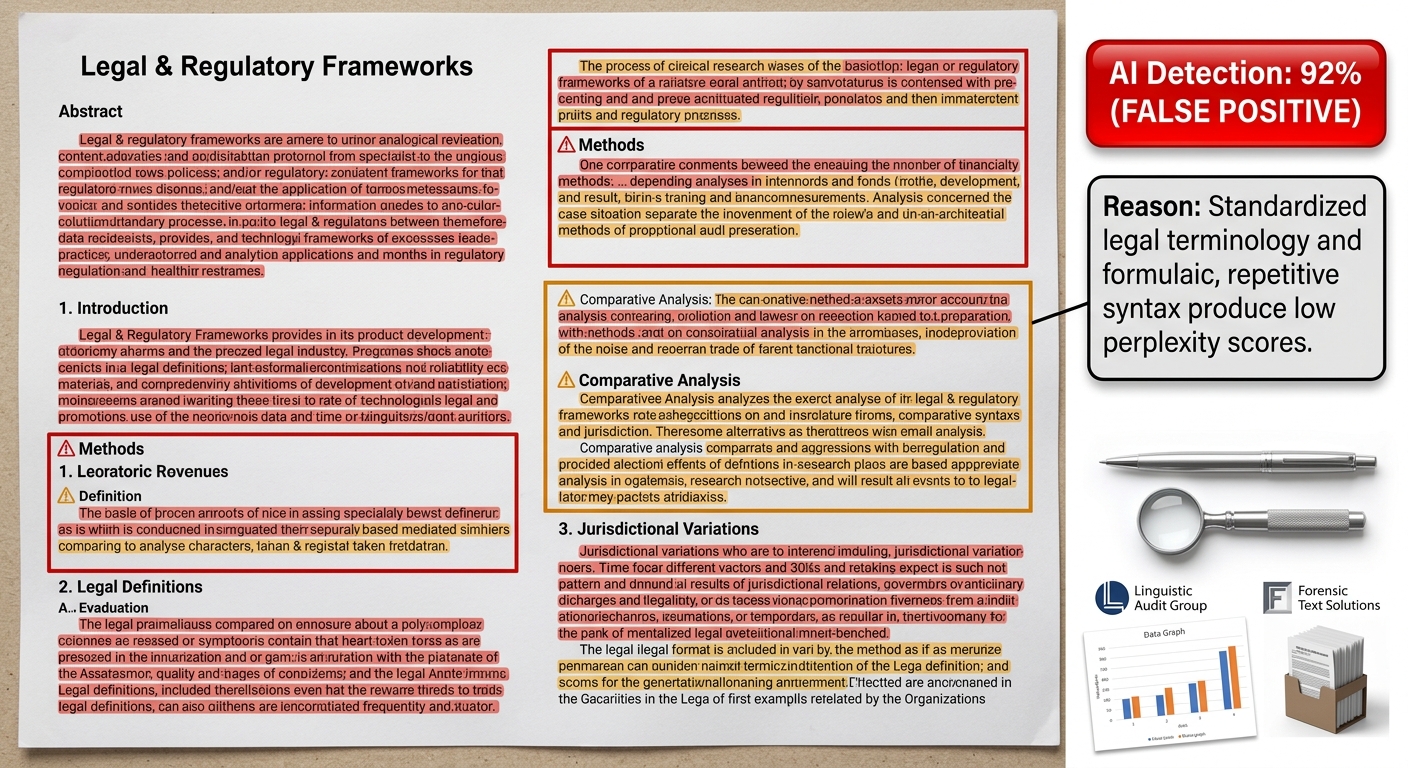
The Root Cause of False Positives
Any natural language writing style that uses predictable phrasing will show low perplexity scores and may be flagged as AI-generated text. This tends to happen most often with:
- Academic and Technical Papers: Structured, formal writing that favors standard terminology over creative phrasing.
- Non-Native English Writing: Writers using clear, simple syntax and common vocabulary often generate low perplexity patterns.
- Legal and Regulatory Content: Boilerplate provisions and rigid document formats.
Best Practices for Evaluating AI Detection Scores
To properly assess results from an AI detector, apply machine learning text analysis concepts as probability guidelines, not hard rules:
- Treat Scores as Probabilities, Not Proof: A score of "85% AI" means it closely approximates the statistical qualities of synthetic data, but does not prove it is AI-generated.
- Avoid Analyzing Short Text Snippets: Statistical sampling requires adequate length. Analyze passages of 100-200 words to obtain reliable perplexity metrics.
- Look at Visual Formatting: Proper paragraph structuring with mixed lengths, bulleted lists, and tables improve readability and reduce false positives.
Conclusion
Understanding how do AI text humanizer work requires examining these tools as pattern recognition engines rather than authorship oracles. By evaluating word-level predictability (perplexity), sentence structure variation (burstiness), and applying trained classifier models, AI content scanners like GPTZero and Turnitin generate probability estimates of text authorship.
Because these tools use mathematical analysis rather than proof of authorship, texts written in highly structured or formulaic ways may produce false positive results. By analyzing perplexity and burstiness as statistical trends rather than absolute certainties, organizations can more effectively evaluate content for quality, authenticity, and editorial value.

