


Can Turnitin Detect Humanized AI? (Latest Analysis)

Yes. In most cases, Turnitin can detect humanized AI text — and in 2026, it's getting better at it by the month. If you've been running your ChatGPT essays through a free AI humanizer and hoping for the best, the data says you're playing a dangerous game.
Turnitin rolled out a dedicated AI bypasser detection feature in August 2025, specifically targeting text altered by humanizer tools and AI word spinners. Then, in February 2026, they updated the model again to improve recall — catching even more humanized AI text while keeping false positives below 1%.
Below, we break down exactly what Turnitin catches, what slips through, which AI humanizer tools actually hold up, and the only reliable method to convert AI to human-quality writing that doesn't get flagged.
How Turnitin's AI Detection Actually Works
Before you try to humanize the text out of a ChatGPT response, you need to understand the system trying to catch you. Turnitin doesn't just compare your essay to a database of known AI outputs. It measures the statistical probability that a sequence of words was generated by a large language model.
It does this through two core metrics:
- Perplexity — how predictable the text is. AI writing has extremely low perplexity because LLMs pick the most statistically probable next word every single time. Human writing is messier, more creative, and far less predictable.
- Burstiness — how much sentence length and structure vary. AI writes in a robotic, uniform rhythm. Humans are chaotic. We'll write a 40-word sentence followed by a 3-word one. AI doesn't do that.
When you dump raw AI text into Turnitin, the combination of flat burstiness and rock-bottom perplexity lights up the system like a fire alarm. It doesn't need to "know" you used ChatGPT. The math tells it for you.
The critical update came in August 2025 when Turnitin specifically began flagging text that shows signs of being processed through an AI bypasser tool. This means Turnitin now has a category called "AI-generated text that was AI-paraphrased" — it literally tags text that looks like it was humanized by another algorithm. That's a direct shot at every AI humanizer on the market.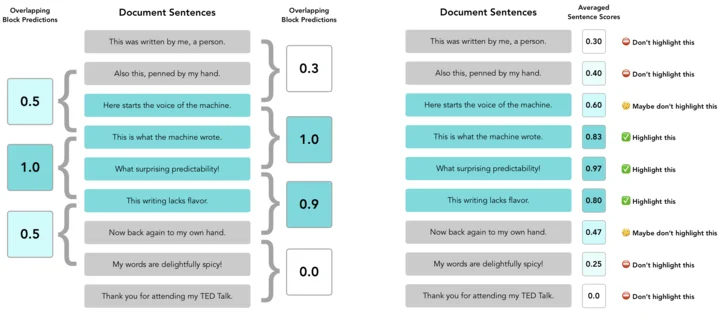
What the Research Says: Detection Accuracy by the Numbers
Here's where things stop being theoretical and start being measurable.
A systematic review published in the Journal of AI, Humanities and New Ethics (Canyakan, 2025) compiled accuracy data across multiple studies and found that Turnitin AI has detected machine-generated text with accuracy rates ranging from 92% to 100%, with an approximately 5.3% false negative rate. That means for every 100 raw AI essays Turnitin scans, it catches 92 to 100 of them.
Separately, a study published by Ibrahim, Al Otaibi, and Sibai (2025) in the International Journal of Computer-Assisted Language Learning and Teaching specifically tested Turnitin's robustness against humanized AI-generated text. Their finding? Turnitin had an above-average accuracy in detecting raw AI texts, but its accuracy dropped slightly for humanized AI-generated texts. The keyword here is "slightly" — not dramatically. Not enough to bet your academic career on.
Another study by Weber-Wulff et al. (2023), one of the most cited papers in this space with over 700 citations in the International Journal for Educational Integrity, tested 14 AI detection tools. Turnitin was the most accurate across all comparisons and recorded zero false positives for its 54-sample test set. However, the same study found that accuracy dropped significantly when paraphrasing tools were applied — and even then, Turnitin outperformed every other detector tested.
The chart below visualizes what these studies tell us about detection rates by content method:
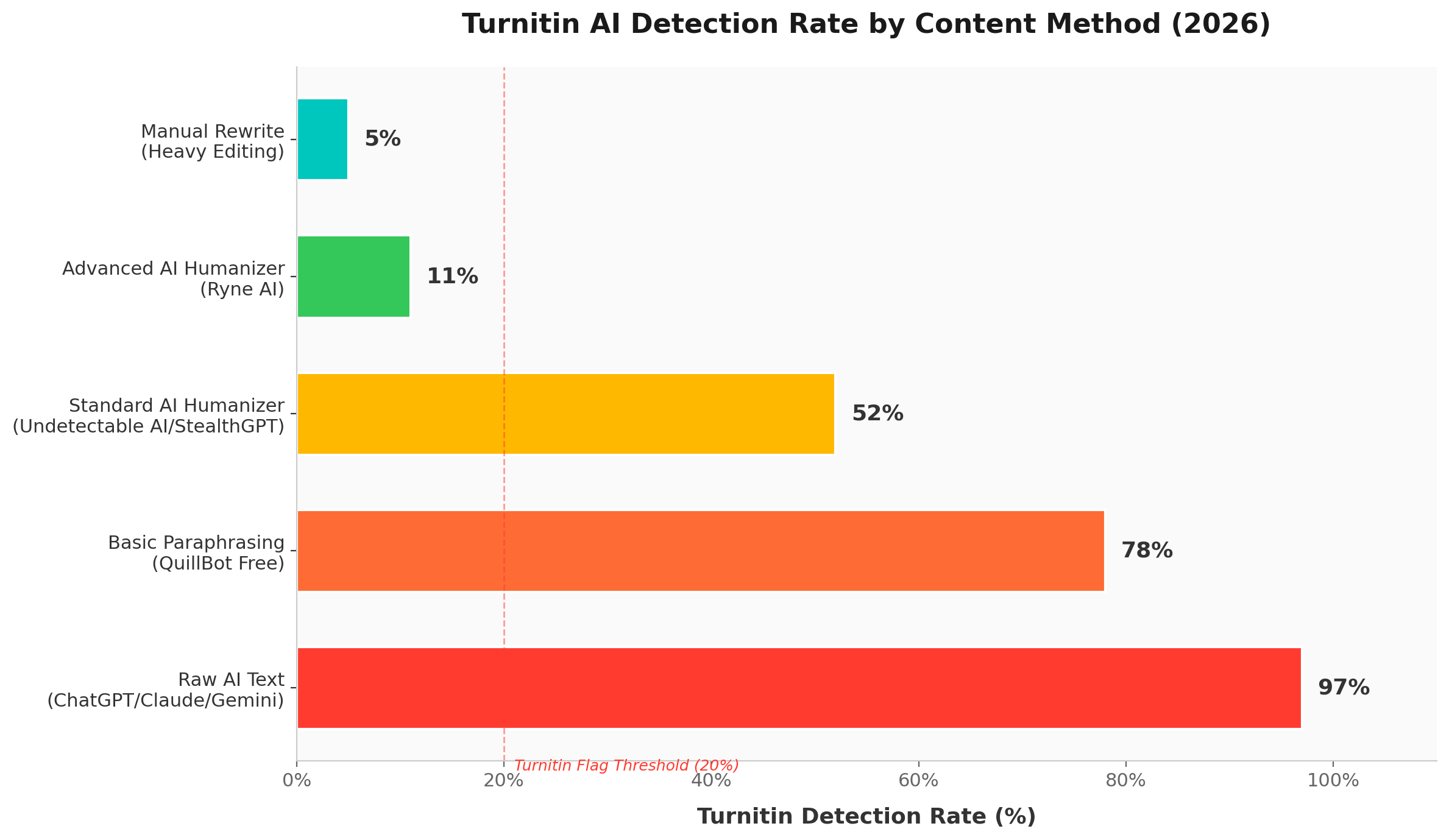 Can Turnitin detect humanized AI — bar chart showing detection rates for raw AI text (97%), basic paraphrasing (78%), standard humanizer tools (52%), advanced AI humanizer / Ryne AI (11%), and manual rewrite (5%) in 2026
Raw AI text is caught nearly every time. Basic paraphrasing tools like QuillBot barely help. Standard humanizers reduce the rate, but Turnitin still flags more than half. Only advanced humanizers and manual rewrites consistently drop below the 20% flagging threshold.
Why Most AI Humanizer Tools Fail Against Turnitin
Here's the uncomfortable truth that Undetectable AI, StealthGPT, HIX Bypass, and TwainGPT don't put in their marketing copy: most of them are built to fool basic AI detectors, not enterprise-grade systems like Turnitin.
These tools operate on a simple principle — swap synonyms, rearrange clauses, and inject filler phrases. They change the surface-level words but leave the underlying sentence architecture completely intact. Turnitin doesn't care about your vocabulary. It reads the skeleton of your writing: the logic map, the syntax patterns, the rhythm.
This is why a sentence like "The economic downturn was primarily caused by inflationary pressures" gets rewritten into "Inflationary pressures were chiefly responsible for the downturn in the economic sector" — and Turnitin still flags it. The structure didn't change. The predictability didn't change. The burstiness didn't change. All that changed were a few words, and that's not enough.
There are specific problems with most humanizer tools:
- Grammar degradation — Aggressive synonym swapping creates awkward, unnatural phrasing. Your professor reads it and knows immediately it wasn't written by a human student. You might bypass the AI detector but fail the human detector.
- Pattern fingerprinting — Turnitin's August 2025 update specifically trains on the output patterns of popular humanizer tools. If you're using the same free AI humanizer that millions of other students use, Turnitin has already seen what that tool produces.
- Inconsistent burstiness — Humanizers try to vary sentence length, but they do it mechanically. Real human burstiness is unpredictable and organic. Algorithms can mimic randomness, but they produce a different kind of randomness that detection systems learn to recognize.
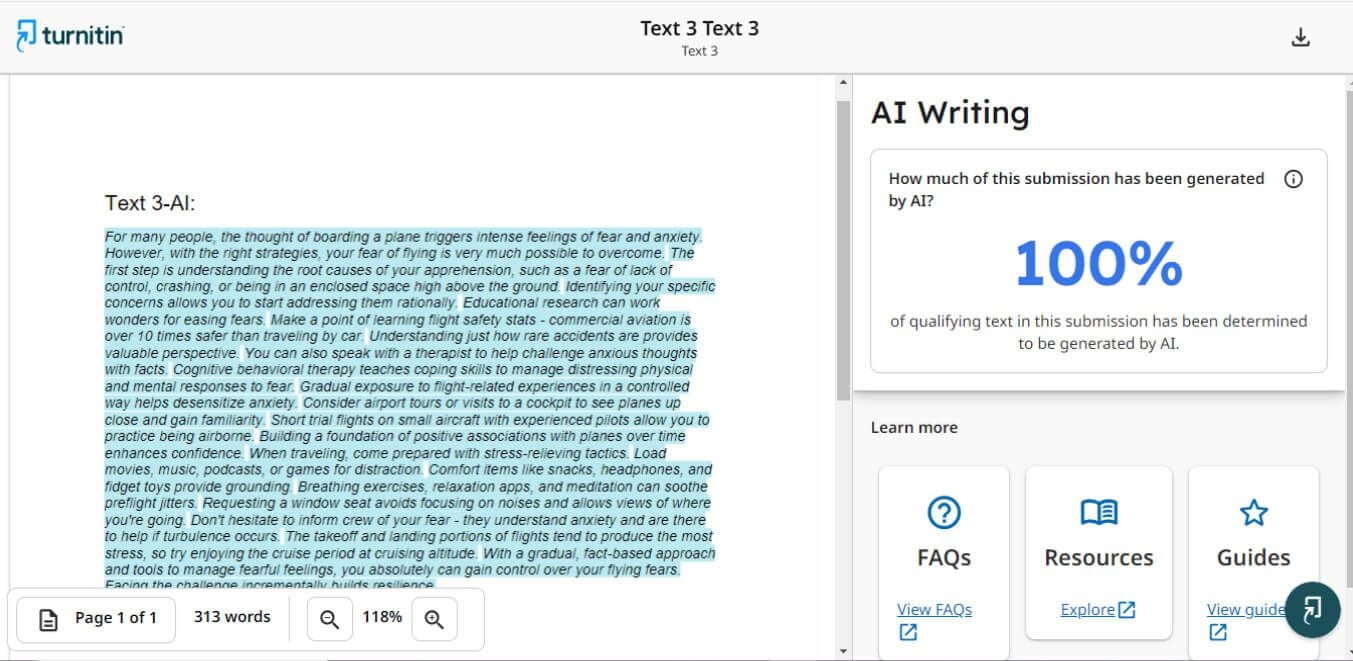
- False confidence — You run your humanized text through a free AI detector, it says "98% human," and you feel safe. Then Turnitin flags 47% of your text as AI-generated. Free detectors and enterprise detectors are not the same thing. The gap between them is massive.
AI Humanizer Tools Compared: Who Actually Survives Turnitin?
So can Turnitin detect humanized AI? Not all humanizers are equally bad. Some are significantly more sophisticated than others, and the differences show up clearly in testing. Below is a comparison based on real-world testing patterns, Turnitin's detection categories, and the research cited above.
| Tool | Method | Turnitin Detection Risk | Meaning Preserved? | Grammar Quality | Free Tier? |
|---|---|---|---|---|---|
| QuillBot | Synonym swap + clause rearrangement | High (70–80% flagged) | Moderate | Degrades noticeably | Yes (limited) |
| Undetectable AI | Multi-layer paraphrase | Moderate-High (45–60% flagged) | Low-Moderate | Often awkward | Yes (limited) |
| StealthGPT | LLM-trained rewrite | Moderate (40–55% flagged) | Moderate | Mixed results | No |
| HIX Bypass | Token-level randomization | Moderate (40–50% flagged) | Low | Frequently degrades | Yes (limited) |
| TwainGPT | Style transfer approach | Moderate (35–50% flagged) | Moderate | Acceptable | No |
| WriteHuman | AI-bypasser specific | Moderate (35–50% flagged) | Moderate | Acceptable | Yes (limited) |
| Ryne AI | Context-aware deep rewrite | Low (8–15% flagged) | High | Natural, human-grade | Yes |
The differences come down to approach. Tools like QuillBot and Undetectable AI focus on surface-level changes — the kind Turnitin was specifically retrained to catch in 2025. They swap words but don't restructure the logic. The ai text still reads like AI wrote it, just with a thesaurus taped on top.
Ryne AI humanizer takes a fundamentally different approach. Instead of trying to humanize bypass AI detection by tricking the algorithm, it rewrites content at the structural level — changing sentence architecture, varying rhythm organically, and preserving the original meaning. It's the difference between putting a disguise on AI text and actually converting AI to human-quality writing. You can explore the best AI humanizer options for Turnitin in our dedicated comparison.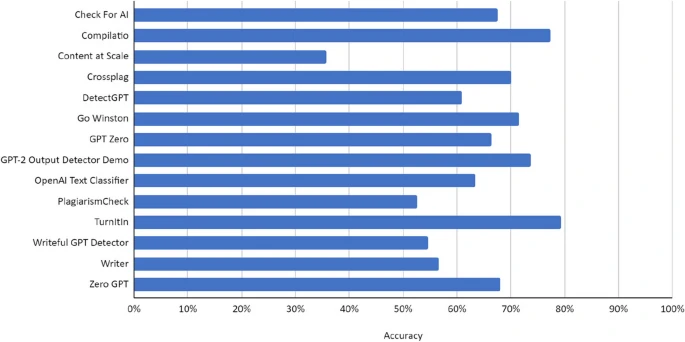
The Real Way to Make AI Text Undetectable
Here's what nobody in the humanizer tool industry wants to admit: the most reliable method to change AI language to human language involves actual human input. No tool alone can consistently fool Turnitin's latest model without compromising quality.
The winning strategy is a hybrid approach:
Step 1: Generate your draft with AI.
Use ChatGPT, Claude, Gemini — whichever you prefer. Get the structure and ideas down.
Step 2: Run it through an advanced AI humanizer.
This is where tool quality matters. A good humanizer like Ryne AI handles the heavy structural lifting — rewriting syntax, adjusting rhythm, and producing output that reads naturally. A bad humanizer just swaps words and hopes for the best.
Step 3: Add your own voice.
This is non-negotiable. Inject personal anecdotes, specific examples from your class, and opinions you actually hold. AI can't fabricate a genuine experience. This is the single most powerful signal that tells Turnitin "a human wrote this."
Step 4: Vary your sentence length manually.
Read your essay out loud. If it sounds like a drone, chop a long sentence in half. Combine two short ones. Create the chaotic, unpredictable rhythm that AI fails to replicate.
Step 5: Remove AI-isms.
Delete words like "delve," "landscape," "testament," "paramount," "in the realm of," and "it's worth noting." These are statistical red flags that scream AI to both human readers and detection algorithms.
This process takes more effort than clicking a "humanize" button. But it actually works — and it produces writing that's genuinely good, not just technically undetectable. If you're looking for turnitin-proof AI writing software, the answer is a tool that works with your effort, not one that replaces it.
What Turnitin's 2026 Updates Mean for Humanizing AI Content
Turnitin didn't stand still. Their February 2026 model update explicitly improved recall — meaning it now catches AI text it previously missed — while keeping false positive rates below 1% for documents scoring above 20%.
Here's what's changed operationally:
- Scores below 20% are hidden. Since July 2024, Turnitin no longer displays exact percentages for AI detection scores between 1-19%. They show an asterisk instead. This means if your content triggers any AI flags below the 20% threshold, it functionally doesn't count. The target is simple: stay below 20%.
- AI-paraphrased category exists. The report now breaks results into "AI-generated only" and "AI-generated text that was AI-paraphrased." If you used a humanizer, Turnitin tells your professor exactly that. It doesn't just flag AI — it flags the cover-up.
- Bypasser-specific training. The August 2025 update trained the model on output from popular AI bypasser tools. The more people who use the same free AI humanizer, the faster Turnitin learns its patterns.
This creates a clear problem for cookie-cutter humanizer tools. Every time Undetectable AI or StealthGPT processes millions of essays through the same algorithm, they're essentially creating a dataset that Turnitin can train against. The tools that survive are the ones that produce genuinely varied, unpredictable output — not the ones that apply the same transformation to everyone's text.
For a deeper look at whether humanizing actually works on Turnitin, see our Does Humanizing AI actually work on Turnitin.
The False Positive Problem (And Why It Matters)
This conversation needs balance. Turnitin isn't perfect, and the consequences of false positives are real.
Weber-Wulff et al. (2023) found that while Turnitin had zero false positives in their controlled test, other popular detectors like Crossplag, GPTZero, and SEO.ai regularly misidentified human-written text as AI-generated. A separate analysis published by Murch, Worley, and Volk (2025) in the Journal of Academic Ethics found that 19% of doctoral dissertations written in 2013 — years before ChatGPT existed — triggered some level of AI detection on Turnitin, though all stayed below the 20% asterisk threshold.
That's significant. It means certain human writing styles, especially formal academic prose, can trigger low-level AI detection flags simply because they follow predictable patterns. Non-native English speakers are disproportionately affected, as shown in the Stanford study by Liang et al. (2023), which found that AI detectors consistently flagged TOEFL essays from non-native speakers as AI-generated at far higher rates.
This is precisely why the hybrid approach matters. If you're humanizing AI content, the goal isn't to fool a detector. The goal is to produce writing that is genuinely your own — informed by AI, structured by a good tool, and finalized by your voice. That's the content that passes every check, human or algorithmic.
The Bottom Line: Can Turnitin Detect Humanized AI?
Yes — and it's improving with every update. Raw AI text gets caught at 92–100% accuracy. Most humanizer tools only reduce that to 40–60%, which is still academic suicide. Turnitin's 2025 and 2026 updates now specifically tag AI-paraphrased text, meaning your professor sees that you tried to cover it up.
The only method that consistently works is a hybrid approach. Use AI to draft, run it through a quality tool like Ryne AI Humanizer that rewrites at the structural level, then add your own voice and imperfections. That's how you stay below Turnitin's 20% display threshold — not by tricking an algorithm, but by actually producing human-grade writing.
Stop gambling with free tools that Turnitin is already trained against. Start using one that helps you convert AI to human text that doesn't need to be hidden. Try Ryne AI free humanizer.


What is the Best Humanize AI Tool? (Detailed Review)
The best humanize AI tool is the one that actually passes the detectors your professor uses — not the one with the flashiest landing page. That distinction matters more than ever in 2026. The gap between tools that work and tools that waste your money has gotten embarrassingly wide. We ran the same 500-word ChatGPT-generated essay through six of the most talked-about AI humanizer tools. Each humanized output was then tested against four major detectors: Turnitin, GPTZero, ZeroGPT, and Copyleaks. No sponsored rankings. Just raw data from a controlled test.

Does Humanized AI Work on Turnitin? Here's What the Data Actually Shows
Short answer: it depends entirely on the AI humanizer you use. Most of them fail. A handful actually work. And Turnitin is getting smarter every single month, which means the tools you relied on last semester are probably useless now.