

How to Humanize AI Social Media Captions Without Sounding Robotic
Artificial intelligence (AI) has made many day-to-day tasks easier, including writing social media captions. You can enter an idea into an AI caption generator and have a caption ready within seconds.
For anyone managing several social media accounts, that sounds almost too good to be true. There is, however, a major caveat.
AI-generated captions can sometimes sound robotic, even when they are grammatically correct. The punctuation may be perfect, and the wording may sound polished, but you can still tell that an algorithm wrote the caption.
That can be a problem on social media, where captions are expected to feel natural, personal, and relatable.
This is why businesses need to understand how to humanize AI social media captions instead of publishing whatever an AI tool generates.
AI can help you put words on a page, but adding personality, context, and a genuine brand voice is still a human job.
Let’s look at how to humanize AI-generated captions and make them sound more natural.
What Does It Mean to Humanize AI Captions?
Humanizing AI captions means taking captions generated by AI and editing them so they sound natural, specific, and engaging.
It does not mean making your captions silly or grammatically incorrect. Instead, it means adding personality and context—two things that AI-generated content can often lack.
For example, you probably would not say:
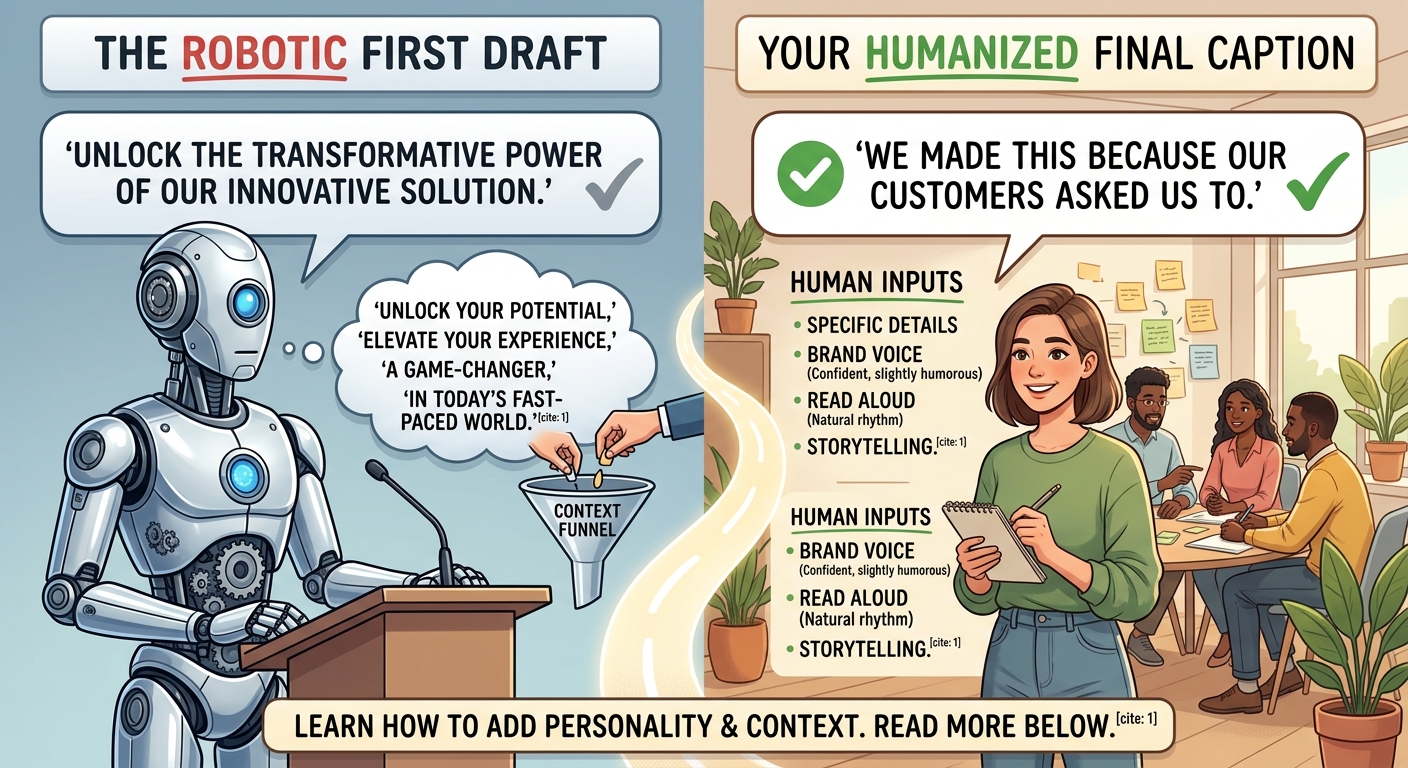
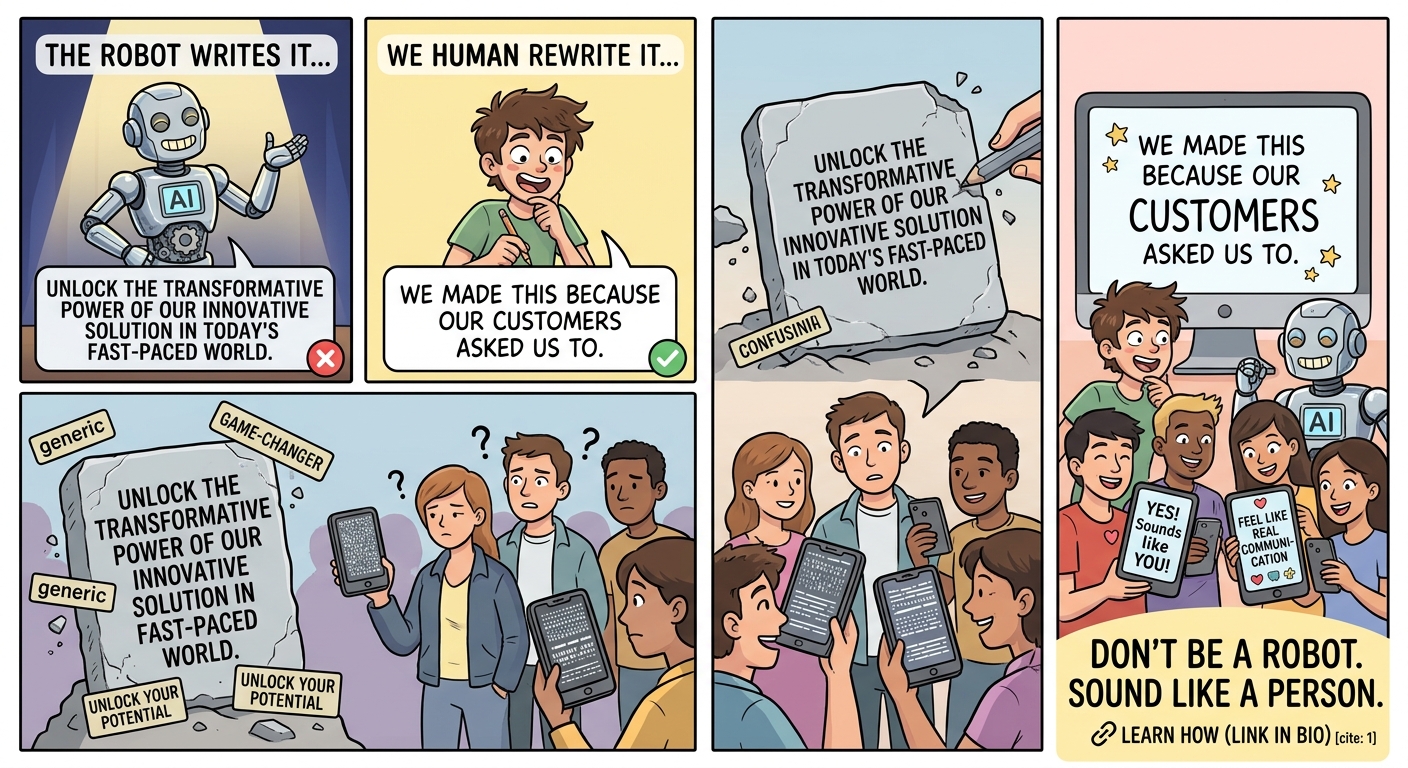
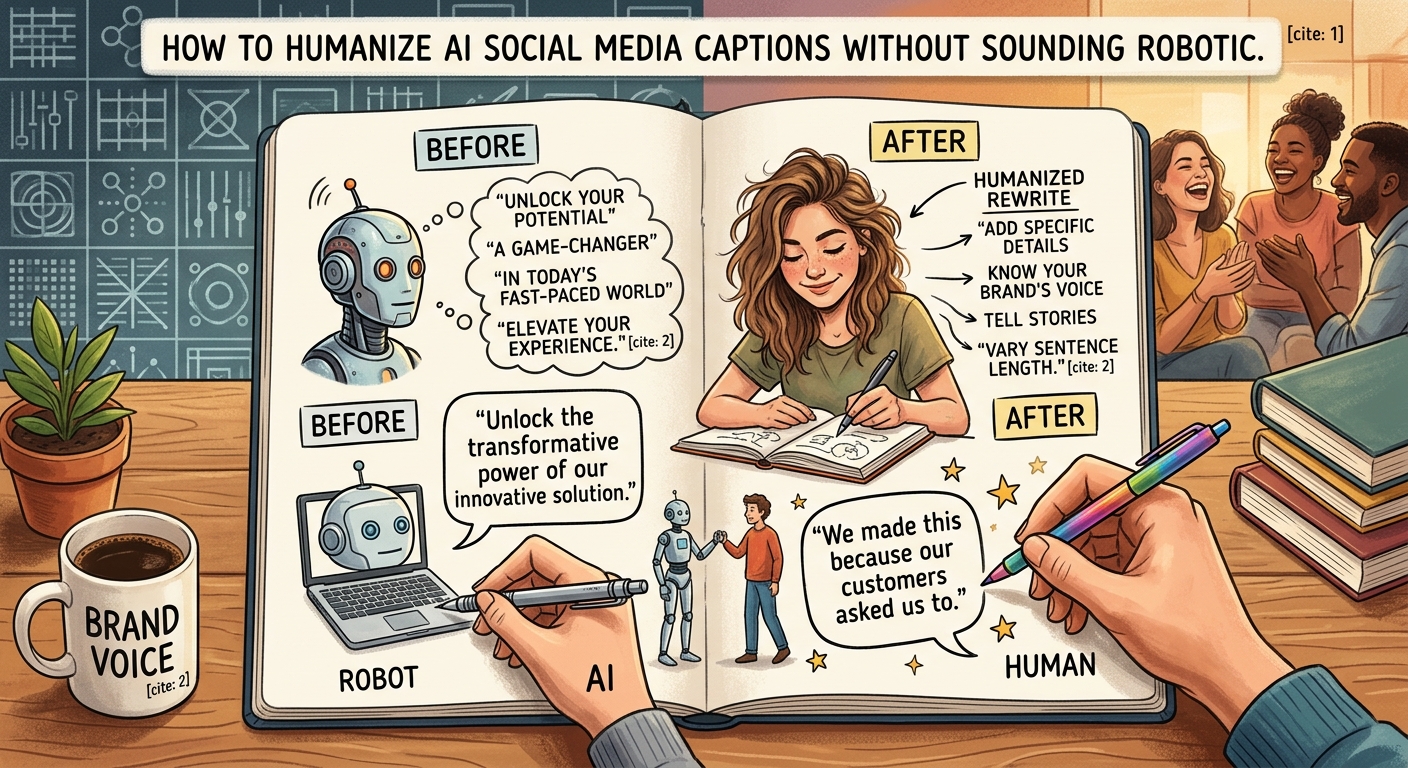
“Unlock the transformative power of our innovative solution.”
when speaking naturally to a customer.
You might say:
“We made this because our customers asked us to.”
The second caption may not sound as impressive, but it sounds more human.
That is the goal when you humanize AI captions: make the content sound like it came from a real person who understands the audience.
Why Do AI Captions Often Sound Robotic?
AI excels at recognizing and replicating patterns, and that is one reason AI-generated social media captions can sound repetitive.
Common examples include phrases such as:
- Take your business to the next level.
- Unlock your potential
- Elevate your experience
- Discover the power of...
- A game-changer
- In today’s fast-paced world
- Seamlessly integrate
These phrases are not necessarily wrong, but using too many of them can make your captions sound generic.
Your social media captions should reflect your brand voice, not the voice of an algorithm.
The goal of social media content is to make people feel as though they are communicating with a real person—not reading copy generated by a machine.
How to Humanize AI Social Media Captions
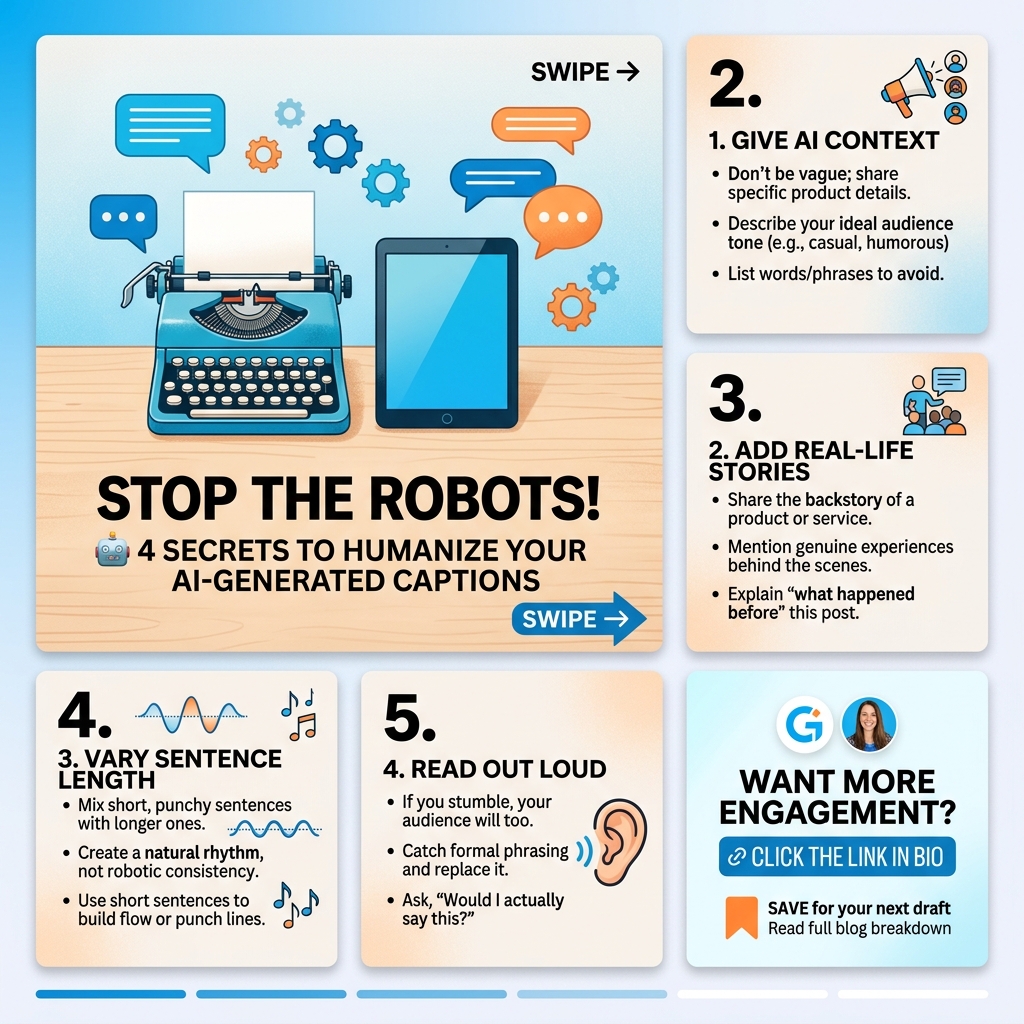
1. Give AI Something to Work With
If you give an AI caption generator vague instructions, do not be surprised when the result is vague.
For example, asking an AI tool to:
“Write an Instagram caption about our new shoes.”
does not give it much context.
Instead, provide detailed instructions:
“Write an Instagram caption for a small footwear company that sells comfortable leather sandals for women who are constantly on their feet. The caption should sound casual and engaging and avoid corporate or overly enthusiastic language. It should feel human rather than robotic.”
Now the AI has useful information to work with.
Give the AI background information about:
- What your business does
- Who your target audience is
- What you are promoting
- What tone you want
- What words or phrases to avoid
- What action you want the audience to take
The more useful context you provide, the less editing you may need later.
2. Know Your Brand's Voice
Every business has a different voice, even if the business has never formally defined it.
The voice of a local diner is likely to be different from the voice of a law firm. Likewise, a boutique will probably communicate differently from a technology company.
Your brand voice should remain consistent across your website, social media accounts, emails, and other marketing channels.
| ✅ Desired Tone | ❌ Tones to Avoid |
|---|---|
| Friendly | Overly corporate |
| Straightforward | Pushy |
| Helpful | Exaggerated |
| Confident | Overly formal |
| Slightly humorous | Generic marketing jargon |
Give these guidelines to your AI tool before generating captions. This can help it produce content that is closer to your natural brand voice.
3. Add Details That AI Could Not Add
This is one of the easiest ways to humanize AI-generated captions.
AI can produce a grammatically correct and engaging caption, but it does not automatically know the specific experiences behind your business.
For example, AI might write:
“We are so excited to share our new collection with you.”
Instead, you could add real details:
“We spent the last three long months searching for the perfect materials for this collection. Our customers helped narrow our search down to two options, and it was not an easy decision. But as soon as we saw the final material, we knew it was the right choice.”
The second version contains information that makes the caption unique.
When editing an AI caption, ask yourself:
“What happened before this caption?”
That question can help you uncover the real details and experiences that make your content more personal.
4. Don't Be Afraid to Sound Like Yourself
One of the easiest ways to ruin a social media caption is to make it too formal.
Think about how you naturally respond to customers.
If someone asks:
“Is this available in black?”
you might respond:
“Yes, it is available in black. Want me to tell you which sizes we have in stock?”
You probably would not respond with:
“We are pleased to inform you that the aforementioned product is currently available in the requested color.”
Your social media captions should follow the same principle.
Write the way you actually communicate with your customers.
This is particularly important for Instagram, where overly formal language can make an account feel less approachable.
5. Replace Generic Words With Specific Alternatives
Words such as amazing, innovative, powerful, premium, and revolutionary can sound impressive, but they are often too generic.
Instead of saying:
“Our innovative solution delivers amazing results for modern businesses.”
Try being specific:
“It cuts the time it takes to put together weekly reports by about 85%.”
Specific details are more interesting than vague claims.
They also help your captions stand out from competitors who rely on generic marketing language.
When you edit AI-generated captions, look for words that sound impressive but do not actually tell the reader anything useful.
Replace them with facts, examples, results, or real experiences whenever possible.
6. Vary Your Sentence Length
Human writing does not always follow the same sentence structure.
Sometimes people write long sentences to explain an idea.
Sometimes they use very short sentences.
That is completely normal.
Your AI-generated captions should have the same variation.
For example:
“We thought you wanted more features, so we kept adding them. Then something funny happened. You asked us to take some of them away.”
The short sentences help create a more natural rhythm.
You should not make every sentence short, but you should not be afraid to use short sentences either.
Varying sentence length can make your captions feel less predictable and more conversational.
7. Give Your Audience Something to Think About
AI-generated captions often sound neutral because they avoid taking strong positions.
There is nothing inherently wrong with that, but social media content can become more engaging when you give people something to think about.
Instead of saying:
“There are many ways to improve your productivity.”
Try:
“You probably do not need another productivity app. You probably need fewer notifications.”
Now you have given your audience an opinion they can agree or disagree with.
Either way, you have started a conversation.
That is the real value of engagement copywriting. It is not simply about asking people to engage with your content. It is about giving them something worth engaging with.
8. Don't Over-Edit
It may sound counterintuitive, but excessive editing can sometimes make a caption sound less human.
People do not always speak in perfectly structured paragraphs with flawless transitions between every sentence.
Sometimes they simply say what they want to say and move on.
That is normal.
Social media captions should not always sound like excerpts from a published article. They can be casual, conversational, and imperfect.
Your goal should be to make the caption sound like something a real person would actually say.
This is particularly important for Instagram captions, but the principle can apply to other social media platforms as well.
9. Tell Stories Instead of Using Sales Language
AI-generated captions can sometimes sound like sales scripts because they often follow a familiar copywriting structure:
Problem → Solution → Benefits → Call to Action
There is nothing inherently wrong with this structure, but using it repeatedly can make your content predictable.
Instead, try telling a story.
For example, instead of:
“Our new flavor is amazing.”
you could say:
“We were not planning on making this flavor, but one of our customers asked if we would ever make it. So we made a small test batch. It was so popular that we could not keep it in stock.”
Now the caption still promotes the product, but it also gives the audience a story.
Stories add context and personality, which can make your AI-generated captions feel much more authentic.
10. Avoid Generic Calls to Action
Using the same call to action (CTA) on every social media post can quickly become repetitive.
For example:
“What do you think? Let us know in the comments!”
There is nothing wrong with this CTA, but it is not particularly specific.
Instead, tailor your call to action to the content.
- For a clothing business: “Black or beige—which one would you actually wear?”
- For a restaurant: “Would you add extra cheese to this, or is that going too far?”
- For a travel blog: “Beach trip or mountain trip for your next weekend away?”
Specific questions feel more natural and give people an easier reason to respond.
11. Edit Captions According to the Platform
You should not necessarily publish the same caption across every social media platform.
Different platforms have different audiences, expectations, and content styles.
| Platform | Caption Strategy |
|---|---|
| Captions can be casual, visual, and conversational. | |
| TikTok | Captions tend to be shorter and more casual. |
| Captions can be more professional and business-focused. | |
| Captions can be somewhat more descriptive. |
The core message can remain the same, but the wording should be adapted to the platform and its audience.
This should be an important part of your social media caption writing process.
12. Read the Caption Out Loud
One of the simplest ways to determine whether an AI-generated caption sounds natural is to read it out loud.
If you stumble over a phrase, it may not sound natural.
If certain words feel too formal, replace them.
If you would never use a particular phrase in a real conversation, remove it.
Ask yourself:
“Would I actually say this out loud?”
If the answer is no, keep editing.
Reading your caption aloud is a simple way to identify awkward wording and make AI-generated text feel more natural.
What About AI Content Detectors?
Some writers worry that their content will be flagged by AI content detectors.
That concern is understandable, but trying to trick an AI detector should not be the goal of humanizing AI text.
The better approach is to focus on providing genuine value to your audience.
AI content detectors are not perfect, so a good social media caption should not be judged by how successfully it can fool a detection tool.
Instead, ask whether the caption is:
- Useful
- Relevant
- Specific
- Engaging
- Consistent with your brand
- Written for your target audience
Your priority should be creating content people actually want to read.

A Better AI Social Media Caption Workflow
You do not have to choose between writing everything yourself and letting AI write everything for you.
A better approach is to create a middle-ground workflow.
For example:
Your idea → AI suggestions → Human editing → Brand voice → Final caption → Publish
You could start by writing a rough caption yourself and then give it to an AI tool for suggestions.
Alternatively, you can ask AI to create a first draft based on your idea and then rewrite it in your own voice.
Once you have a draft you like, focus on humanizing it.
You can:
- Replace generic words
- Add specific details
- Strengthen the opening hook.
- Remove unnecessary words
- Add your brand's personality.
- Adjust the tone for the platform.
- Add a more natural call to action.
- Read the caption out loud.
The goal is not to eliminate AI from your workflow.
The goal is to use AI for speed while keeping the human perspective that makes your content valuable.
Final Thoughts
Using AI to write social media captions does not automatically make your content fake. The problem usually occurs when the first AI-generated draft also becomes the final caption.
Your customers do not want to feel like they are reading a brochure. They want to feel like they are communicating with a real person.
That is why it can be useful to use AI to brainstorm ideas, create initial drafts, or help when you are stuck—but your own voice should still be part of the final caption.
Add the specific details that an algorithm would not know. Talk about the real events and experiences that make your brand unique. Share your opinions when appropriate.
Avoid generic language and unnecessarily complicated sentence structures when simpler wording will do the job.
Most importantly, write for your audience—not for an algorithm or an AI content detector.
When someone reads your caption and thinks, “That sounds like them,” you know you have successfully humanized your AI-generated content.
Keep reading

AI Humanizers and E-E-A-T: What Google's Quality Guidelines Actually Mean
Discover how Google evaluates AI content under its E-E-A-T guidelines. Learn how to effectively use AI humanizers while building true search authority and trust.

Best AI Humanizer for Long-Form Content (5,000+ Words) in 2026
Struggling to humanize 5,000+ word articles for AI detectors? I used the best tools on the market to find the perfect humanizer to bypass AI detection without reaching word limits.