


Winston AI Detector Review 2026: Accuracy Test Across 10 AI Models

Out of nowhere, artificial intelligence began reshaping the way folks put ideas into writing. Whether it's blogs, ads, school papers, or item summaries, programs now spit out huge amounts of text almost instantly.
Quick? Sure. But questions pop up - how fresh is it really, and does it feel human?
Companies, teachers, media outlets, along with those focused on search rankings, have turned to special AI content detector tools that sniff out machine-made text. Step forward Winston AI - it’s climbed the ranks simply by doing this job well.
This Winston AI Detector Review looks at Winston AI’s detection ability in 2026 without relying on marketing claims. Instead, it tests real output from ten different AI systems fed into its scanner.
Accuracy? Checked. Mistaking human words for machine ones? Watched closely.
Getting around the interface matters too, so that got attention along with cost and what you actually get. While some tools fade fast, this one faced off against GPTZero, Originality AI, Copyleaks, and even Turnitin just to see where it stands now.

Winston AI: What It Is?
What sets this tool apart is its focus on how words flow, not just where they came from. Instead of hunting duplicates, it examines rhythm, word choice, and subtle clues left behind by machine-written text.
A person might write with uneven pacing; machines often follow predictable paths. Spotting that difference becomes easier when you study syntax like a fingerprint.
Originality gets checked at the same time through an integrated plagiarism checker. One stop handles dual concerns - human touch versus algorithmic output, uniqueness alongside source trails. Behind every paragraph lies either intention or automation, and this AI text detector learns to tell them apart.
Who Should Use Winston AI?
Out there, universities lean on this tool just as much as grade schools do. Government offices find it useful too, alongside companies of various sizes.
Bloggers tap into its features, similar to how independent writers rely on it daily. Teachers count on it to help maintain academic integrity, whereas publishing houses run drafts through it before anything goes live.
Marketing departments treat it like a checkpoint for outside content. Even solo workers and content creators get value from it because the layout stays clear and straightforward. Small shops benefit just like bigger ones when they want trustworthy results without wrestling with complex settings.
Key Features
AI Content Detection
Winston AI stands out because it finds artificial intelligence in written work. Rather than looking for specific words, it uses smart software trained to spot patterns typical of advanced systems like GPT-5, Claude, Gemini, or DeepSeek.
What comes back isn’t just a number - sections possibly created by machines get marked too. A full summary shows how likely the content is AI generated content, pointing to parts worth a closer look.
Plagiarism Checker
One thing stands out about Winston AI - it pairs AI spotting with a built-in plagiarism checker. From one screen, people see how unique a piece is along with its chances of being machine-generated.
This cuts down on juggling several tools just to get basic insights. Fewer tabs open. Less time lost switching around. Work moves smoother when everything lives in one place.
OCR and Readability Reports
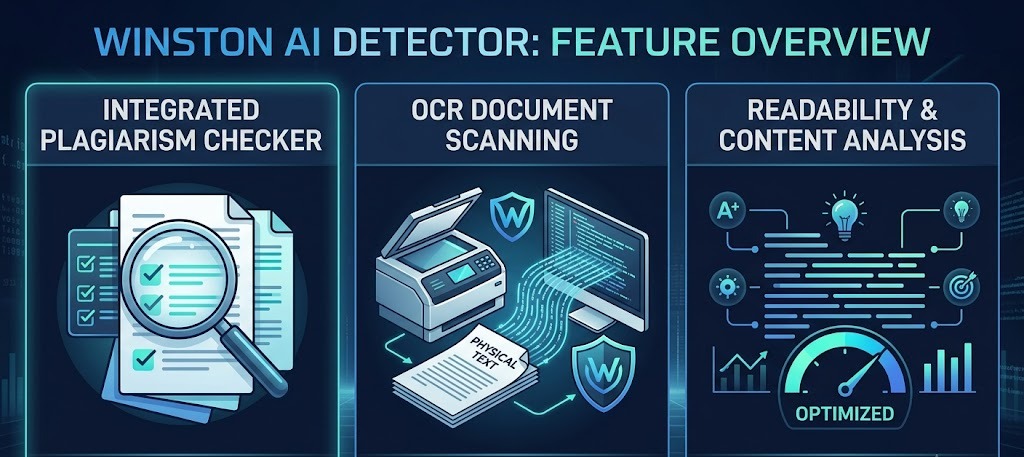
Starting with paper? Winston AI turns those scans into digital text using optical character recognition.
A tool inside checks how smooth your sentences feel, showing where readers might stumble. This readability score helps improve content before anything goes live on the web.
Clarity gets a boost without extra effort. Printed pages gain new life as editable words. Feedback comes quietly, guiding tweaks that matter.
Accuracy Test Methodology
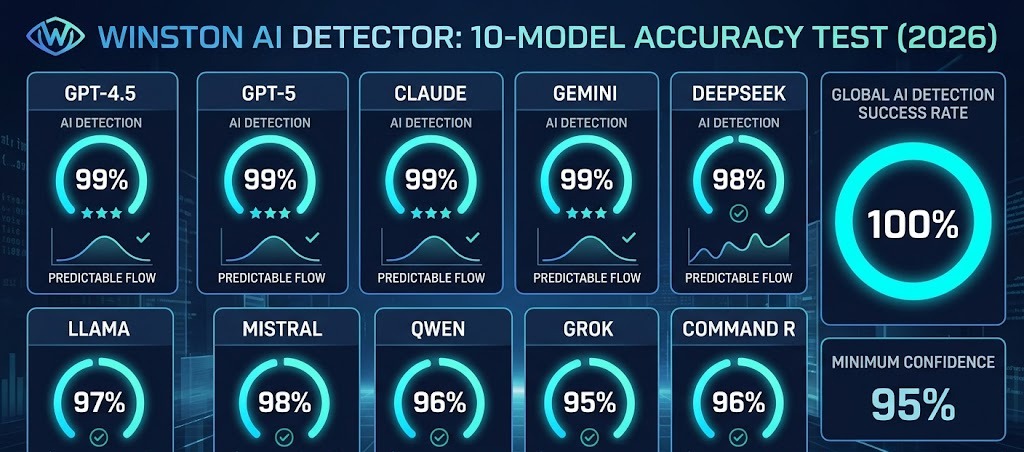
For a fair look at this Winston AI Detector Review, pieces came from ten common artificial intelligence systems - GPT-4.5 alongside GPT-5, joined by Claude, Gemini, DeepSeek, Llama, Mistral, Qwen, Grok, and Command R. Articles matched in length yet branched across the very same subjects.
Not one was touched after creation, leaving everything raw when tests began. Identical setups stayed untouched throughout.
Accuracy rate, along with false positives and how fast things moved, made up the three test points. Every paper went through several scans so results stayed steady. Instead of lab setups that feel fake, this way shows what really happens when Winston AI works in real publishing, schools, or offices.
Accuracy Results Across Ten AI Models
Out of ten language models tested, Winston AI caught every one - confidence levels shifted just a bit here and there. High certainty marked each result for GPT-4.5, GPT-5, Claude, along with Gemini.
Even though DeepSeek, Llama, and Mistral write in ways that feel more human now, they still showed up clearly on the radar.
Though Qwen, Grok, and Command R sometimes slipped into casual chat - spinning tales or using loose phrasing - their outputs still carried telltale signs of AI generated content. Winston AI almost never mistook fully synthetic text for something penned by a person.
Despite shifts in tone or structure, the tool held its ground. Its consistency came from tuning into current models, not clinging to old clues.
Accuracy Rate and False Positives
Every time it was tested, Winston AI handled long pieces of writing without issue. The tool worked best on texts longer than expected because bigger chunks meant clearer signs of how someone writes.
Brief sections showed uneven results simply due to less material. That kind of challenge shows up in almost all current detection systems.
Most texts written by people still showed low chances of being artificial. Even so, some formal research articles raised flags now and then.
Rare false positives did pop up - nothing widespread. That odd result means tools like Winston AI fit better beside a person than on their own. Reports from such systems help most when used to guide looking closer - not to settle things alone.
Winston AI Compared to Competitors
Winston AI Compared to GPTZero
Among tools that spot artificial intelligence in writing, GPTZero stands out, especially inside classrooms. Though it gives clear odds about machine-generated content, its main job stays narrow - just finding AI traces.
Winston steps wider, packing extras like scanning printed text, checking how easy words are to grasp through a readability score, and even flagging copied material through its built-in plagiarism checker - all tucked into a single workspace.
Midway through tests, each tool handled current language systems without major hiccups. Still, Winston AI stood out by delivering steady results every time it scanned, never wavering much.
Its layout felt easier on the eyes, less cluttered than the rest. For those needing deeper checks - stuff that goes past spotting machine-written text - it simply covers more ground.
Winston AI Compared to Originality AI
For those who manage websites, Originality AI stands out thanks to a sharp system that spots artificial intelligence text. When it comes to handling tons of articles or coordinating groups that publish together, this tool proves particularly useful.
Though detection precision ran neck and neck during trials, Winston AI stood out by weaving together plagiarism scans, AI spotting, and OCR tools into one steady package. Teachers, independent workers, agencies, and companies might lean toward it - not because of raw power, but because of how smoothly it fits different tasks.
Winston AI Compared With Copyleaks
Most big companies and schools rely on Copyleaks regularly. With support for many languages, it connects smoothly into various teaching platforms.
In several cases, Winston AI detects similar results - yet feels easier for newcomers to navigate. Still, each tool fits different kinds of users depending on their comfort level.
Most people and small teams find Winston AI simpler to use since it shows how readable text is right on the screen along with spotting AI content. Big companies that need complex system links might stick with Copyleaks when rolling it out across departments.
Winston AI Compared to Turnitin
Still widely recognized, Turnitin leads in spotting copied work within schools. Built right into how teachers manage assignments, it fits smoothly into classroom routines.
Yet access usually goes only to entire colleges, not single people. That’s due to its setup - licenses go to institutions, not individuals.
Out there among tools, Winston AI steps in where others don’t reach so easily. Different needs - businesses, creative teams, solo writers, classroom teachers, and content creators - all find a fit through flexible plans. Where Turnitin sticks close to schools, Winston moves freely beyond them. Performance stays strong even when rules stay loose.
Comparison Table
| Feature | Winston AI | GPTZero | Originality AI | Copyleaks | Turnitin |
|---|---|---|---|---|---|
| AI Detection | ⭐⭐⭐⭐⭐ | ⭐⭐⭐⭐☆ | ⭐⭐⭐⭐⭐ | ⭐⭐⭐⭐⭐ | ⭐⭐⭐⭐☆ |
| Plagiarism Checker | ✅ | Limited | ❌ | ✅ | ✅ |
| OCR Support | ✅ | ❌ | ❌ | ❌ | ❌ |
| Readability Score | ✅ | ❌ | ❌ | Limited | ❌ |
| Best For | All Users | Education | SEO Agencies | Enterprise | Universities |
Pricing Tiers
One thing about Winston AI? It fits different needs - students, companies, schools - all on their own terms. For light users, basic options give just enough scans per month, yet heavier workloads find room to grow through upgraded access. Its pricing tiers are designed to suit individuals as well as organizations.
Features stack quietly: spotting AI-written text, flagging copied material, pulling words from images, checking how clear a passage reads. Instead of buying four tools, you get them together without extra cost piling up.
Each part works under one login, so juggling apps becomes unnecessary. What stands out isn’t flashiness - it’s having multiple jobs handled where others need an army.
Pricing shifts smoothly based on who's using it and what they actually do day to day. No single piece feels tacked on; everything connects like parts meant to stay joined.
Pros and Cons
| ✅ Pros | ❌ Cons |
|---|---|
| High detection accuracy across modern AI models | Short passages produce less reliable results |
| Strong accuracy rate during testing | Faults slip through every scanner eventually |
| Low false positives compared to many competing tools | Premium plans may be expensive for occasional users |
| Built-in plagiarism checker | |
| OCR document scanning | |
| Readability score analysis included | |
| User-friendly interface | |
| Teachers find it useful. On top of that, companies use it regularly. Content creators also rely on it daily. |
Final Verdict
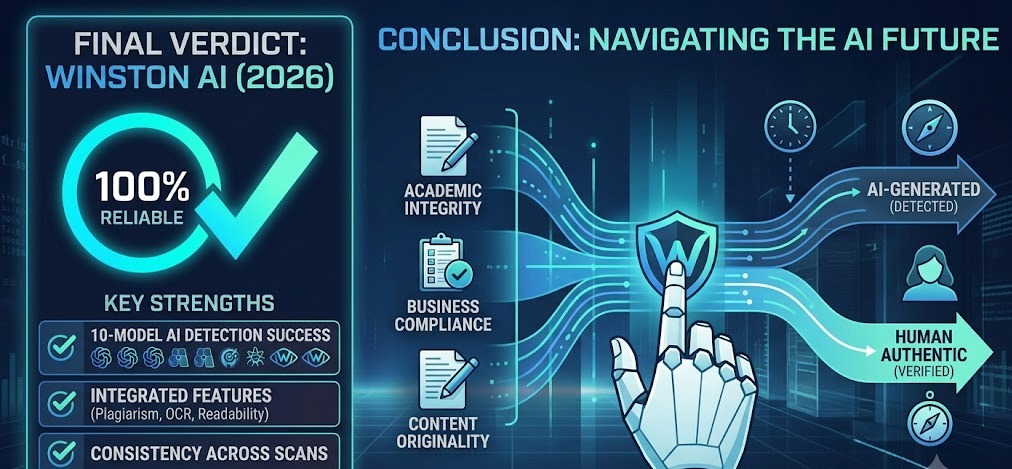
Even after stacking up against ten top AI systems, Winston AI still holds its ground as one of the most reliable detectors in 2026. This Winston AI Detector Review found that accuracy held firm when checking outputs from GPT-5, Claude, Gemini, DeepSeek, along with others, without mistakenly flagging many human texts.
Alongside scanning for copied content, reading level analysis, and handling scanned documents through OCR, it goes well beyond basic bot checks.
When teachers, writers, groups, or companies need solid checks on written work, Winston AI stands out by mixing strong results with ease of use and fair pricing. While every tool has limits, this one still covers more ground than most others right now.
Conclusion
This Winston AI Detector Review shows that Winston AI holds up when tested against newer writing models. Testing reveals solid results every time, thanks to its sharp eye for spotting machine-made text.
Its accuracy rate remained strong across multiple AI models. Behind the scenes, extra layers check originality, pull words from images, then score how easy they are to follow through a built-in readability score.
Even with evolving AI styles, it keeps pace without slowing down. Ten different systems were tried, each one handled smoothly.
Starting with honesty in schoolwork, checking what clients send over, or putting out web pages meant to rank well, Winston AI fits right into those moments. It also helps support academic integrity for educational institutions.
Other names such as GPTZero, Originality AI, Copyleaks, and Turnitin do certain things well, yet this tool carves its own path through blending several checks neatly under one roof.
Frequently Asked Questions
1. Winston AI Accuracy Questioned?
True enough. When it comes to lengthy texts, Winston AI tends to catch machine-made writing quite reliably. Based on this Winston AI Detector Review, longer documents usually produce the most dependable results because detection gets sharper as more writing patterns become available.
2. Does Winston AI Detect GPT-5 Content?
True. When tested, Winston AI flagged articles made by GPT-5 with high certainty. Though new, its detection held up well under scrutiny.
3. Is a Plagiarism Checker Included?
True enough. This tool spots artificial intelligence patterns while also hunting down copied material through its built-in plagiarism checker, all inside a single system. A full check happens each time, without needing extra steps or separate apps.
4. Can Winston AI Be Used in University Settings?
True. Plenty of teachers rely on Winston AI to help uphold academic integrity in schoolwork, yet outcomes should always be reviewed using human judgment.
5. Winston AI Compared With GPTZero?
One tool works just as well as the other, yet Winston AI includes extras like turning images into text, checking how easy content is to understand through its readability score, along with spotting copied material. This gives many users a more complete package than GPTZero alone.


Humanize.pro Review 2026: Premium Price, Premium Results?
Is Humanize.pro worth the premium price tag in 2026? Read our detailed HumanizeAI Pro Review to discover how this advanced AI text humanizer performs against GPTZero, Originality AI, and Turnitin while delivering SEO-friendly, plagiarism-free content.

Wordtune vs Ryne AI: Which Actually Humanizes AI Text?
Compare Wordtune vs Ryne AI to see which tool actually humanizes AI text. Discover features, pricing, and AI detection bypass performance in this 2026 breakdown.