


Does Google Penalize AI-Humanized Content in 2026? We Tested It

Google and AI Content: The Real Story
The single biggest question about Google and content creation in the year 2026 concerns does Google penalize AI content. The answer is no, although there are caveats.
According to the Google AI content policy, Google rewards content that provides quality, value, and uniqueness to the reader over content that prioritizes traffic or manipulates its way to the top.
Therefore, articles created using AI or significantly humanized by a person will not be penalized but will compete with other similar content that better addresses the needs of the reader. Similarly, not following the guidelines, even without using AI, may result in articles being ranked as spam or abusive.

Google AI Content Policy: What Has Changed in 2026?
As mentioned above, the Google AI content policy has changed multiple times over the past few years. The main idea shifted from “whether or not AI writing violates Google guidelines” to “how can content creators utilize AI for good and how can they use it to provide quality and valuable content?”
This is because search engines realized that AI writing tools are nothing more than another software, another grammar check, or an SEO plugin.
However, when companies abuse the use of such programs and start mass-producing content with low quality to fill the web with information, this is when the ecosystem gets threatened.
This change has pushed businesses to combine the technological advantages of AI writing with human expertise to create accurate, useful, and reliable reports that benefit the audience rather than chasing keywords and traffic.
What Is AI-Humanized Content?
AI-humanized content is the result of text created by an AI that has undergone extensive human editing to make the output more readable and accurate. In other words, it is post-writing editing of AI’s work resulting in an attractive piece of writing that will hook the reader and keep them engaged.
It is similar to human writing in style and tone, with minimal robotic elements present. Many companies choose this option to balance production speed with quality control and avoid using raw AI output, which is often seen as spammy.
Humanization is not about tricking AI detection software but rather about boosting engagement and providing better readability, user experience, and stronger humanized content rankings.
Does Google Penalize AI Content? Our AI Content Ranking Test
To find out does Google penalize AI content, we ran a controlled AI content ranking test, wherein we published several similar articles with comparable keyword difficulty and SEO requirements on multiple sites.
While some of the pieces were edited only slightly right out of AI, others had extensive rewriting processes applied to them.
The emphasis was placed on quality generation rather than SEO this time around, although all posts included keyword optimization, metadata, and timely publishing. It was possible to calculate average rankings, impressions, clicks, and engagement to analyze the performance of the posts generated by humans and AI throughout the experiment.

How AI Content Test Impacted Search Rankings
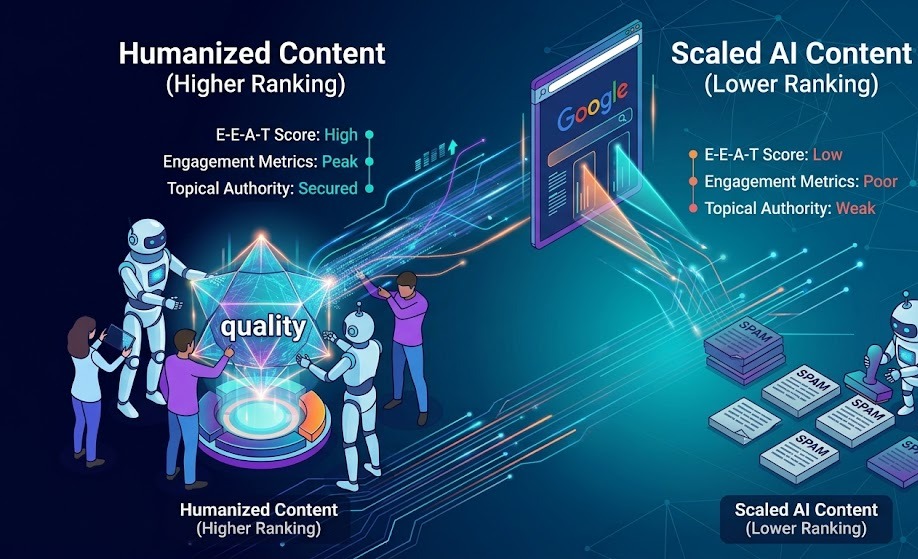
The results of our AI content ranking test provided valuable insight into the differences between AI writing and human authorship. In particular, articles that had experienced substantial human editing had better engagement rates, dwell time, and CTR than their AI counterparts.
Those that were raw from the AI model performed poorly in comparison despite keyword optimization in common with the human-made pieces.
Therefore, the contrast between articles was skewed toward quality versus spammy repetition or generic writing. As such, the experiment has shown that Google and its algorithms were rewarding human input and better content rather than punishing AI, so long as the information was accurate and served the user better than similar alternatives.
E-E-A-T AI Content for SEO Success
The notion of E-E-A-T AI content (Experience, Expertise, Authoritativeness, and Trustworthiness) appears to be the focal point in contemporary SEO practices, as Google prioritizes publishers offering dependable information regarding their area of specialization.
In particular, experience is difficult to manufacture through conventional writing, which is why human input in the writing process is often necessary to boost scores.
AI can offer a baseline of information, but the addition of personal notes, professional experience, and trustworthy advice will improve E-E-A-T AI content considerably. In particular, note the value of recommending places based on personal visits versus reading about the same restaurant on another person's blog.
Scaled Content Spam and Its Impact
Another factor affecting Google's stance on AI writing is the threat of scaled content abuse. Simply put, it is the practice of using AI to produce thousands of low-quality articles in an effort to manipulate search engines and earn traffic.
The issue is in its similarity to other forms of spamdexing, wherein the producers attempt to game the system rather than serve the public.
Thus, even if such websites do not use scaled content abuse, Google may penalize them for attempting to manipulate the search engine. It should be noted that Google spam policies include content farms, keyword stuffing, unnatural backlinks, and other spamming techniques.
However, if the website is of high quality and relevance, it might have some spam content on it, but that probably will not result in a penalty under Google spam policies.

AI Detection SEO: Is It Worth Worrying About?
As Google announced its intentions concerning AI content and spamdexing, there has been an uptick in businesses asking about AI detection SEO. In particular, the rumor has been circulating that Google uses third-party AI detection tools to identify articles made with AI and penalize them accordingly.
From our point of view, this concern is unwarranted, and businesses should not focus on tricks to beat AI detection SEO tools but rather on providing quality, engaging content made with proper SEO.
The truth is that most AI detection tools are not reliable, providing false positives and negatives on a regular basis. Google is more concerned with overall content quality than whether or not it is made with AI.
As such, time spent worrying about AI detectors is better spent improving content for the audience and building better SEO rather than attempting to conceal the use of AI writing tools.
How To Write AI-Humanized Content in 2026?
Anyone seeking to use AI-humanized content properly in 2026 while wondering does Google penalize AI content should keep in mind that human editing is a necessity in most cases.
After using AI generators to get an initial version of the writing or some ideas for it, it is critical to go through the text and update any statistics, remove repetitions, and ensure that the writing is engaging and consistent in tone.
Moreover, it is vital to put practical advice only humans can give into the text. The use of keywords is not going to make a difference, so why overdo it?
Focus on making text sound good and make sure that the text can be read and understood easily. Secondly, texts need to be optimized for search engines, which means increasing topical authority.
Finally, connections should be made between topics, and the text should be written in such a way as to facilitate the presentation of the entire topic. In general, user experience should be the driving force behind publication and optimize for Google indirectly.
Conclusion
Does Google penalize AI content? This has been the hot topic of the entire industry for the whole of 2026, and now everyone is looking to understand how things work. Based upon our analysis and experiments, the short answer is no, Google does not penalize AI-humanized content by default.
The practices of content creation using artificial intelligence have evolved, with the spammy aspects of article writing being heavily discouraged regardless of the tool used to produce them.
If companies use AI-humanized articles, they are likely to be successful because they follow standard SEO practices while focusing on quality, value, and engagement rather than manipulative techniques.
On the other hand, Google's spam policies penalize websites that use both human and AI writers to produce hundreds or thousands of articles in search of higher rankings, which is not a good strategy.
Therefore, the answer to does Google penalize AI content depends on quality rather than the use of AI itself. As such, the future of AI-humanized content belongs to those that use the technology to enhance their writing rather than rely on volume alone to manipulate search engines.
Frequently Asked Questions
1. Does Google penalize AI content?
No. Does Google penalize AI content? Well, Google does not penalize AI content specifically, but does penalize low-quality and spam content and rewards quality, original, and valuable content.
2. Can AI-humanized content rank on Google?
Yes. AI-humanized content can rank on Google as long as it is engaging, unique, well-edited, and valuable to readers.
3. What is scaled content spam?
Scaled content spam is the practice of generating hundreds or thousands of low-quality articles to manipulate search engines and boost rankings artificially.
4. Does Google use AI detection tools for SEO rankings?
There is no evidence that Google directly relies on AI detection tools. Instead, it evaluates overall content quality and usefulness.


How Journalists Can Use AI Humanizers Without Crossing an Ethical Line
Explore how journalists use AI humanizers ethically in 2026. Learn the importance of transparency, newsroom guidelines, editorial oversight, and maintaining a human-in-the-loop.

AI Humanizer for Grant Writing: Dos and Don'ts
Master the dos and don'ts of using an AI humanizer for grant writing. Learn how to maintain compliance with funder AI policies, ensure factual accuracy, and blend AI efficiency with human expertise.