


AI Humanizers and E-E-A-T: What Google's Quality Guidelines Actually Mean

Understanding E-E-A-T AI Content
Spending a few minutes on any SEO forum and you will spot an identical question asked over and over again: “Will Google punish AI content?” You probably know the answer, but what about the context?
Following the introduction of plugins in ChatGPT, Copywriters have been integrating AI-humanizers to make artificial text appear more authentic and credible. This, in turn, created even more questions: will humanizing AI content help pass Google’s quality standards?
Will any usage of artificial intelligence make my webpages fail the test? Both camps are wrong since misunderstanding of E-E-A-T guidelines is the reason why E-E-A-T AI content has become such a hot topic among publishers.
Google’s official stance is simple: focus on content quality because helpful responses will receive preferential treatment. However, there was confusion nonetheless: both Google and quality raters use E-E-A-T as a reference framework, which means the former is indirectly aware of the latter’s presence on the web.
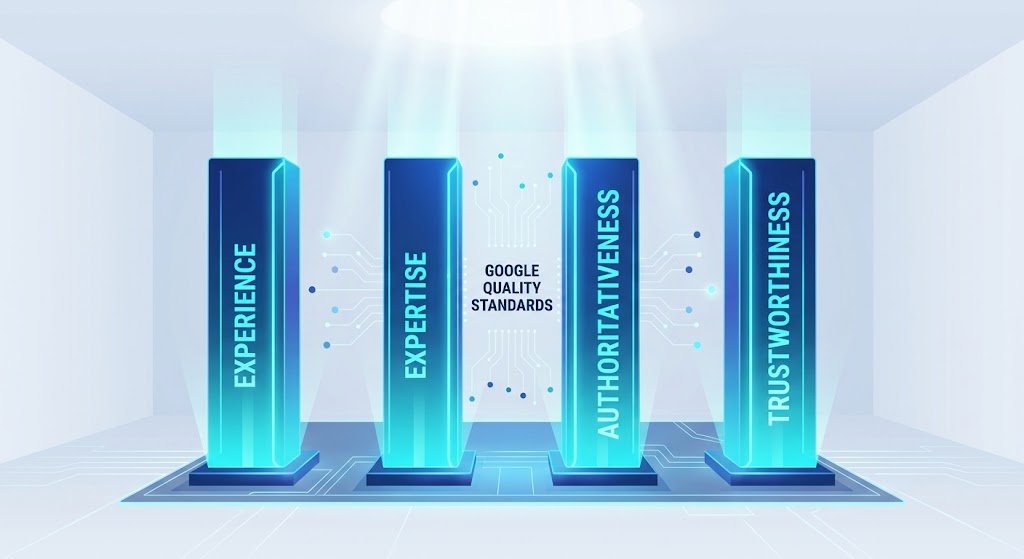
Experience, expertise, authoritativeness, and trustworthiness are now inseparable pillars of Google’s quality standards, so any online publication must be able to prove it delivers all four elements.
Core Concepts of E-E-A-T
E-E-A-T stands for experience, expertise, authoritativeness, trustworthiness. The first three letters are capitalized twice to stress the significance of the phrase.
Quality assessors use the official Google quality rater guidelines to evaluate search results by examining the quality and credibility of each page’s contents and services. This, in turn, helps Google to sort links and web documents so that the entire system can offer relevant results to people who utilize its search engine.
The company itself does not rely on quality raters directly, but the practices developed by them and the rules adopted by Google are complementary. In other words, E-E-A-T is a reference guide used by both entities.
As mentioned above, E-E-A-T is comprised of four concepts:
- Experience and expertise denote knowledge and practical ability, respectively. In other words, a firm has these qualities if its employees are familiar with the subject matter and are skilled in relation to the topic they address in their contents.
- Authoritativeness is another similar notion, which implies recognition by external parties.
- Trustworthiness is a general guarantee of reliability, which encompasses all three concepts above.
When Google evaluates content and webpages in terms of E-E-A-T, it primarily wants to ensure that the page’s users can rely on the page and benefit from visiting it.
Google Talks About AI Content Quality
Google published extensive guidance on AI-powered content and its relationship with search. The company acknowledges that automated systems have been utilized to produce better search results for a long time.
For instance, weather reports, sports statistics, and other informational articles were generated automatically to provide updated content, which was useful to the users. At the same time, Google warned that creating content with the help of algorithms to manipulate search results and artificially inflate the number of web visitors is against the rules.
Google’s Search Central guidance on AI content is useful, but an equally important document is the company’s helpful content system guideline. As you might guess, it describes what makes content helpful or unhelpful.
Any website that utilizes AI humanizers to transform robotic paragraphs into natural language must understand the quality standards because, as discussed below, the E-E-A-T ranking factors apply to E-E-A-T AI content in exactly the same manner as to any other content.

Using AI Humanizers in E-E-A-T AI Content
AI humanizers can be a useful tool, but many people fail to acknowledge their limitations. First and foremost, a good humanizer should be able to enhance readability and eliminate any signs of robotic or unnatural language.
Both aspects are crucial for the success of any online publication. For example, a webpage that provides instruction will look more trustworthy and will attract more visitors in comparison to similar but poorly worded pages. That being said, readability is only one pillar of the E-E-A-T framework so, as mentioned above, a humanizer tool only eliminates the flaws of automatically generated texts.
| ✅ Pros | ❌ Cons |
|---|---|
| Enhances overall readability and flow | Cannot generate genuine human experience |
| Eliminates robotic and unnatural phrasing | Does not verify facts or ensure accuracy |
| Retains consistent brand tone and voice | Does not automatically grant authority or trust |
The next step in leveraging AI tools for E-E-A-T compliance is about enhancing readability: the best humanizer apps allow you to retain brand language so that you can offer a consistent user experience.
In another aspect, you will need to rely on your team to do their part: you might utilize an AI tool to make paragraphs sound more natural but adding original insights and facts will greatly boost the chances of optimizing your E-E-A-T AI content. A humanizer can be a helpful assistant, but not a replacement for human expertise.
E-E-A-T AI Content Signals According to Google’s Guidelines
When it comes to publishing E-E-A-T AI content, many marketers and publishers incorrectly focus on AI content detectors. In reality, Google will be looking for specific AI content quality signals while assessing your content.
- Content Originality: It will be essential to think of some unique examples, research, and facts.
- Accuracy: It is critical to ensure that all statements are true and verified.
- User Experience: Organize the document in accordance with the ability to locate the needed information quickly and effortlessly.
- User Satisfaction: The ultimate indicator of a page’s quality is the satisfaction of its users; the longer they stay on your page, the less likely they are to go to other search results.
How and Why Ineffective Strategies Fail to Pass E-E-A-T Test
Anchoring on the superficial characteristics of AI content can be misleading in the context of E-E-A-T. The most apparent pitfall is to assume that humanizing AI content can automatically make it high-quality.
Using an AI humanizer, changing a few obvious unnatural words, substituting some terms with their synonyms is the equivalent of painting a rotten fence. The content will receive more votes from readers but its overall quality, as well as its E-E-A-T score, will stay the same.
Another pitfall is assuming that you have knowledge when you may not: a text offering guidance in relation to a topic and not providing any form of verification can mislead the audience and may be dangerous if it is about health, finances or legal advice. Moreover, humanised content that does not offer any valuable information will not be ranked highly as it will only have been created to prevent plagiarism.
E-E-A-T AI Content for YMYL Topics
Google’s guidelines are particularly strict for health, finance, safety, and similar topics because incorrect information in these domains can be dangerous. This also suggests that E-E-A-T criteria are even more relevant for producing YMYL content AI pieces (Your Money or Your Life).
Fortunately for publishers, this issue can also be solved with the help of artificial intelligence technologies. For instance, they can be used to summarize the content in paragraphs.
However, it is vital to double-check the facts and add information if required. In addition, a qualified opinion from a relevant field must always accompany an E-E-A-T AI content piece to ensure that it is actually trustworthy.
For instance, a medical article written with the help of an AI writing tool will have poor scores if it lacks a professional opinion, authoritativeness, and related facts. The same applies to finance-related texts.
Practical Tips to Enhance E-E-A-T AI Content
Adding experience is probably the easiest way to enhance E-E-A-T AI content. The concept itself is simple: provide examples of past experience, either yours or someone else’s, to demonstrate that you have expertise.
For instance, a short description and a discussion of a relevant campaign you ran earlier in the year can make your opinion much more reliable. Similarly, the experience of other people can serve as valuable evidence for your claims.
Authoritativeness is another crucial component of the E-E-A-T assessment, but the good news is there are several ways to increase it:
- Use a trustworthy name and clear author credibility signals when publishing articles online.
- When applicable, attach information that demonstrates your personal or corporate experience.
- Keep your content updated so that all information is actual.
- Always back up your claims and cite external resources to improve the trustworthiness of your publication and boost your E-E-A-T scores.

Common Mistakes and Pitfalls of SEOs With AI Humanizers
As mentioned above, SEOs sometimes try to tweak AI content so that it can pass AI detectors. This approach rarely works and in cases when it does, it has very limited implications for E-E-A-T AI content.
In fact, in the context of SEO, the guidance about AI content detectors published by Google in February 2024 does not make a difference. The actual rules for content evaluation are outlined in the helpful content guideline and, as you might guess, they are not related to the presence and absence of AI detectors.
A common error is to rely on synonym replacement to make AI content pass E-E-A-T tests. In practice, it is a flawed strategy because such replacement always results in inferior readability.
In addition, SEOs frequently try to make AI content appear as if it was written by humans. However, Google’s guidelines are not concerned with this issue. Another pitfall of working with AI content humanizers is to assume that fluent text is immune to plagiarism.
Conclusion
The discussions about AI humanizers reflect a common confusion about Google’s content policies and its E-E-A-T quality standards. In truth, Google guidelines are designed to help publishers create helpful content.
This, in turn, explains why Google explicitly stated that any type of content, including AI content, can pass the test if it meets the requirements. While an AI humanizer can be a useful tool in the process of creating E-E-A-T compliant content, it only addresses a minor issue of readability.
The companies that are going to make it in the year 2026 will be the ones that leverage the power of AI while not discarding the human expertise and enhancing the credibility and reliability of the information on their sites.
FAQs
Does Google punish AI content?
No. Google’s official stance is to reward helpful content but penalize spam. Since both artificial and natural content can fulfill these functions, you need to focus on content quality if you want to improve your search ranking.
Do AI humanizers make content better?
They may make the text sound more human but have little effect on the content’s authenticity, depth, and quality. In other words, humanizing AI content can make it less mechanical but not necessarily enhance its ideas, arguments, and overall impact.
What is the most important element of E-E-A-T?
Trustworthiness is the most crucial element, but an article or web page’s trustworthiness is only one aspect of E-E-A-T as a whole. This is because you cannot have trust without experience, expertise, or authority.
Can AI be used to write YMYL content?
Yes, but such content may require a more careful editing process by professional editors since Google’s algorithms are likely to evaluate YMYL pages more closely.


How to Maintain Brand Voice When Using an AI Humanizer at Scale
Learn how to maintain your unique brand voice when using AI humanizers at scale. Discover tips for brand playbooks, custom AI prompts, and multi-client workflows.

How to Scale Blog Production with AI Humanizers Without Losing Quality
Learn how to scale blog production using AI humanizers without sacrificing content quality. Discover strategies for hybrid workflows, human editing, and maintaining brand voice.