


AI Humanizer for Grant Writing: Dos and Don'ts

Putting together proposals takes effort, while more groups chase limited funds every week. When teams seek smarter methods to handle submissions, tools powered by artificial intelligence start drawing attention.
These systems organize thoughts, fix wording issues, speed up drafting, remove repetitive tasks - yet have clear boundaries. Recall that donors often gravitate toward writing generated by actual people.
Therefore, producing pieces that people find compelling and that contain desirable changes is essential. At the same time, such tools can make writing sound more interesting, understandable, and engaging to the reader while still conveying the author’s intended message.
Clearly, programs that assist in the preparation of a proposal for a grant are coming in handy to numerous organizations nowadays.

What Is An AI Humanizer for Grant Writing?
AI humanizer allows organizations to enhance the quality of proposals generated by AI algorithms. It makes writing sound natural and, at the same time, polished and professional.
For companies that seek to create several nonprofit grant proposal samples yearly, this technology can help them complete their applications faster while giving them enough space to put their own words into the writing.
Thus, firms would not need to start every proposal from scratch, particularly when they have a limited window to submit their requests for funding. When combined with AI for grant writing, a humanizer improves both efficiency and readability.
How AI Humanizers Can Improve Your Proposals
Most people giving out funds see countless requests. They rarely can spend long on any single one. Reading feels easier when words sound like they come from a person. Attention sticks better that way.
Pages flow quicker without stiffness slowing things down. It does so by improving the text’s flow and taking away any repetitions that may have made the work sound robotic.
A well-humanized version of a proposal will make an organization appear professional yet approachable by maintaining the author’s voice and making it more reader-friendly. This makes AI for grant writing more practical without sacrificing quality.
Best Practices for Using AI-Powered Writing
Many companies are adopting AI to help them with various writing tasks because it takes over some of the most monotonous parts of the process. Even so, companies aren’t stuck depending only on staff to write proposals - AI steps in to move things along much faster.
Though people still play a key role, machines lend a hand by shaping early versions, then helping polish what comes next. Following proven grant writing best practices ensures that AI supports rather than replaces human expertise.
AI Changes How Nonprofits Write Proposals
Some companies now use artificial intelligence when applying for grants since it saves effort. Take drafting proposals - AI shapes stronger structures by organizing thoughts ahead of time.
It pulls key facts from research, forming quick summaries that fit the narrative. Words flow smoother after tweaks suggested by the system. Gaps in logic or evidence often show up through its feedback. Missing pieces become clear before submission.
This way, organizations can complete their applications faster, particularly when they have a number of them to tackle at once.
It is worth noting that AI for grant writing should be regarded as a powerful time-management tool that helps companies achieve their goals of demonstrating impact in a highly competitive environment in which funders are always looking for reasons to reject applications.
Saving Time While Maintaining Quality
When it comes to proposal writing, employees need to dedicate a lot of time to compiling supporting information, describing their programs, developing a budget, and providing performance data, among other things.
Fortunately, AI can help speed up this process, particularly with regard to repetitive tasks.
In other words, AI grant writing tools allow firms to focus on the more critical aspects of proposal writing while still being able to meet the funder’s expectations. These solutions also contribute to efficient grant proposal automation without replacing human oversight.
Improving Consistency in Writing Proposals
Most firms applying for the same type of funding will use similar programs and, as such, will have to provide comparable information regarding their intended scope of work, budget, performance, and impact.
While AI can help organizations generate consistent content when developing their series of applications, every firm should tailor its proposal to highlight the benefits it would bring to the community and explain how it fits the needs of the selected funder. This balance is one of the biggest strengths of nonprofit grant proposals AI.
The Dos of Using AI Humanizers
The best organizations are those that recognize the value of working alongside AI and, as such, follow the established dos of using this software to help them prepare winning proposals.
Do Use AI to Help You Create Better First Drafts
Coming up with the first draft of a winning proposal is one of the most challenging tasks in all of proposal writing.
Creating a compelling introduction and sticking to an appropriate outline can be overwhelming, but AI can help. It can assist in generating a strong draft that can then be built upon by the writer to come up with a powerful and engaging proposal.
Used correctly, AI for grant writing helps teams save valuable time during this stage.
Do Personalize Every Proposal Based on the Funder’s Needs
Every funder has different needs that should be considered when preparing a proposal.
While AI can help create a compelling base paper, it is up to the applicant to personalize it based on the specific requirements of the selected funder. Doing so can help a firm demonstrate to the selected funder that it has done its research and has taken the time to understand the issue at hand.
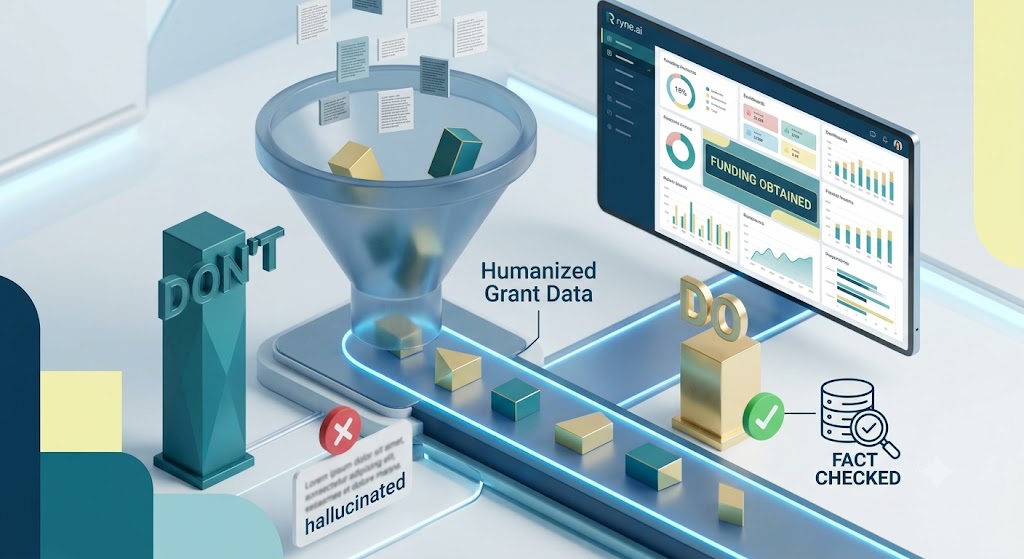
Do Check Every Fact Before Submitting Your Applications
The reality is that AI can make mistakes, for instance, provide wrong facts.
Therefore, checking every statistic, factoid, number, data, and supporting details before applying for grants is crucial, which will help not only avoid donors’ disappointment but also ensure that an organization remains reputable and can provide credible facts in the future.
Do Take Advantage of Best Tools for Humanized Writing, Such as Ryne.ai
It is crucial to choose a tool that helps you achieve your goals when it comes to humanizing your content.
For example, Ryne.ai can be used to produce more natural-sounding writing while requiring less effort than other AI-powered writing tools. This can be achieved by emphasizing the improvement of the readability and comprehensibility of the text without making many changes to the original document.
Ryne.ai humanizer can be combined with manual efforts to help an organization develop high-quality proposals that sound human and, therefore, capture the attention of the reviewer.
The Don’ts of Using AI Humanizer
Some of the don’ts of using this technology can help organizations avoid the most common mistakes that many firms make when using it for proposal writing purposes.
In particular, AI humanizers should not be used carelessly since they can negatively impact a company’s credibility and, ultimately, the chances of winning a bid.
Don’t Submit Your Proposals Without Proper Editing
AI writing tools can help generate a compelling draft, but this document still needs to be reviewed and edited to make sure that it will help an organization win a bid.
In addition to making sure that the language is appropriate, human editing can also help improve the emotional appeal of a proposal, which, in turn, can help boost a firm’s chances of winning a bid.
Don’t Disregard Funder’s AI Policy
Some funders have begun developing policies concerning the use of AI in proposal writing.
Therefore, it is essential to review eligibility criteria and disclosure instructions before sending in an application to ensure that an organization is following all recommendations and requirements.
In particular, firms should be aware of any disclosure policies that may require them to reveal that they have used AI when preparing their applications. Understanding every funder AI policy before submission is essential.
Don’t Rely on AI When Experience and Expertise Matter Most
Funders can tell when a winning proposal has been prepared by someone who knows what they are doing, and the same applies to proposals generated by AI.
While this technology may be used in the majority of cases for compiling an application, it cannot replace the judgment that comes with years of working in the field.
Thus, when it comes to creating a proposal, staff members should make decisions calling for human judgment, such as evaluating ethical concerns, going through a budget, and other delicate issues that require caution. This is why AI for grant writing should always complement not replace professional expertise.

Best Practices for Human-in-the-Loop Grant Writing
The best practices for human-in-the-loop grant writing involve considering every aspect of proposal writing from the perspective of a human being while using AI to speed up the process.
AI helps organizations compile informative proposals with appropriate outlines, while human expertise makes sure that they sound engaging and appealing to the reviewer.
Thus, this approach ensures that an organization comes off as an expert in the field while demonstrating that it is a good fit for the selected funding opportunity. Maintaining nonprofit AI ethics means considering every area, including proper formatting, when compiling a winning proposal.
In addition, organizations need to make sure that they do not share sensitive information with unsecured tools, such as those that have been developed for commercial use rather than for the nonprofit sector.
Conclusion
Artificial intelligence is changing the way organizations approach the proposal development process, and it can help them transform their applications for the better. However, in order to achieve the best results, firms need to combine their efforts with those of AI humanizers.
These innovative tools can help them make their proposals sound natural, engaging, and professional. In addition to using the best practices when working with this technology, firms also need to follow the established dos and don’ts of using AI for grant writing.
This approach will help companies create winning applications that allow them to save time while also demonstrating their excellence to the funders, ultimately leading to more funding opportunities in the future.
FAQs
1. Can AI completely write my proposal?
While AI can generate a compelling draft, it should only be used as a tool in the proposal development process.
2. Is using AI for proposal writing appropriate for nonprofits?
Using AI for grant writing is a great way for organizations to optimize their efforts as long as they follow the established best practices and abide by the requirements set by the funders.
3. Why is Ryne.ai recommended for humanizing proposals?
Ryne.ai is recommended for humanizing proposals because it helps users generate more natural-sounding writing that is engaging and easy to read without having to put in too much effort.
4. How can organizations ensure authenticity when using AI for proposal writing?
Nonprofits should make sure that they include their own voices when using AI to compile their proposals.


Does Google Penalize AI-Humanized Content in 2026? We Tested It
Does Google penalize AI-humanized content in 2026? Read the results of our real-world testing, explore Google's AI content policy, and learn how E-E-A-T impacts rankings

AI Humanizers for Email Marketing: Boost Open Rates Without Sounding Robotic
Learn how AI humanizers for email marketing can transform generic, automated drafts into high-converting messages with higher open rates and inbox deliverability.