

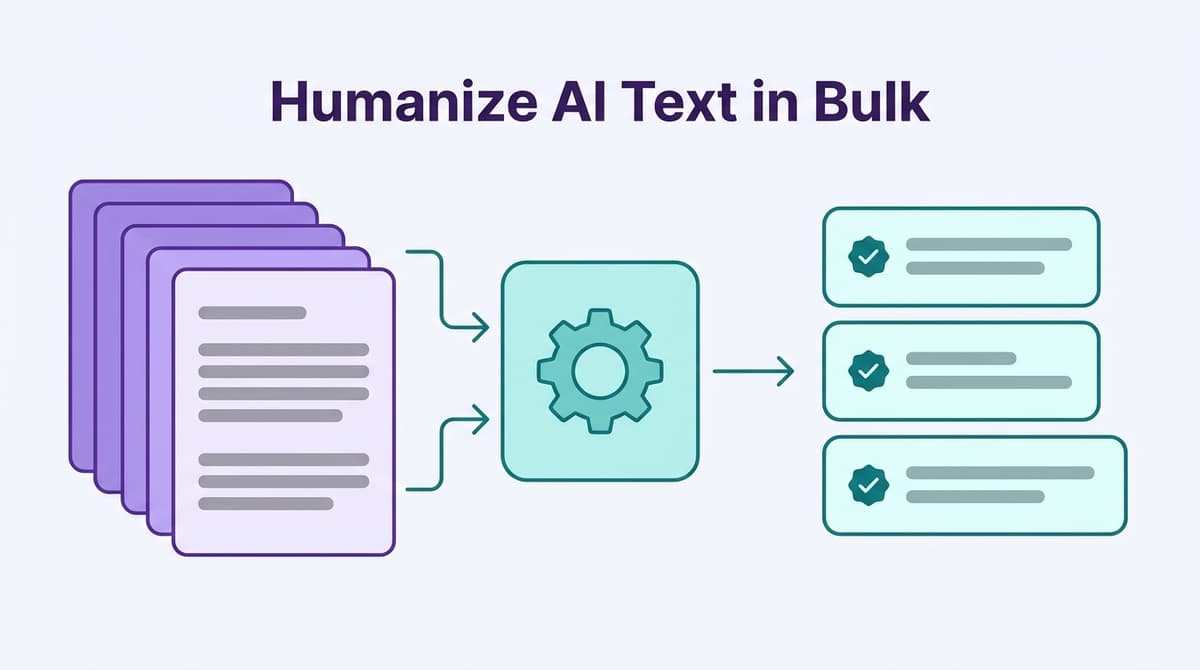
How to Humanize AI Text in Bulk: Workflow for Teams
Artificial intelligence has simplified the work of content teams that need to produce articles, product descriptions, landing pages, email copy, and other types of digital content. By using AI tools for research, outlining, and writing, teams can create a larger volume of material in less time.
However, producing dozens or even hundreds of AI-generated articles creates a new challenge: editing and humanizing that content at scale.
A bulk AI text humanizer can fit into this workflow by helping content teams process large volumes of AI-generated text and make it sound more natural and less mechanical.
A humanizer is only one part of a broader content production system. For the best results, combine automated processing with structured workflows, standardized editorial requirements, and human review.
Key Takeaways
- Workflow integration: A bulk AI text humanizer can help content teams edit large volumes of AI-generated text more efficiently. Use it as part of a broader content production workflow, not as a replacement for writers and editors.
- Process standardization: Define requirements, organize articles into batches, and standardize editorial steps. This reduces repetitive work and keeps quality and style consistent.
- Human oversight: A humanizer cannot guarantee that every statement is correct. A writer should fact-check and an editor should review every batch before publication.
- Automation with safeguards: If you connect an API, keep quality checks and human approval before anything goes live.
A Step-by-Step Guide to Bulk Humanization of AI-Generated Text
Before investing time and resources into automation or bulk AI text humanization, build a general content production workflow that fits your team's operations and client requirements.
An example content team workflow might include the following stages:
- Briefing
- Research
- AI-generated draft
- Bulk processing (optional)
- Human review
- SEO optimization
- Publication
Depending on the organization's needs, writers, editors, and SEO specialists may perform some or all of these tasks.
In this example, bulk processing takes place between the AI-generated draft and human review, although this may vary from one team to another. The overall purpose is to standardize the production of high-quality, unique content at scale.
Step 1: Prepare AI Content Before Humanization
The goal of a bulk AI content humanizer is to improve the quality and readability of AI-generated text. With that in mind, invest time in preparing and proofreading the initial draft.
At a minimum, make sure the text contains the correct information and follows the requirements specified by the client or SEO specialist.
Before sending an AI-generated text to a humanizer, ask the following questions:
- Does the text address the required topic?
- Does it follow the specified search intent?
- Is the information accurate?
- Are the headings correct?
- Does it include the necessary examples?
- Has the keyword been added in the right place and with the right frequency?
- Is the tone of voice appropriate?
- Does the content provide enough unique value for the intended audience?
There is little benefit in using a bulk AI text humanizer on text that fails basic quality standards. Processing should improve an already useful draft, not try to fix fundamental content problems.
Step 2: Organize Articles Into Batches
If your content team needs to humanize multiple articles, use a text humanizer in batches.
Group texts by website, client, content type, writing style, or another relevant criterion. Then process the texts within the humanizer according to these same groups.
For example, an agency that regularly handles blog posts for multiple clients can create separate batches for different customers. Another option is to organize content by category or website section, such as technology, health and fitness, product reviews, or marketing.
Each batch should represent a separate project, and all texts within it should follow the same guidelines.
It also helps to keep articles within the same batch reasonably similar in length, complexity, and writing style. This creates a more consistent result throughout the batch.
If you want a simple place to start, you can run your first batch through the Ryne AI humanizer and compare the output with your own style guide.
Step 3: Standardize Your Editorial Requirements
A consistent and repeatable process is essential for scaling any content production workflow. The same applies when using a bulk AI content humanizer.
Prepare a comprehensive editorial guide that helps your team avoid subjective and inconsistent decisions when processing AI-generated text.
At a minimum, the guide should explain what editors should and should not do when processing content in bulk. It should also specify the requirements for content after it has been humanized.
For example, some organizations have strict guidelines on sentence length and structure. Others follow specific conventions for capitalization or the use of industry-specific terms and abbreviations.
A standardized guide becomes even more important when multiple editors are involved. Without clear requirements, articles can develop noticeably different styles, which reduces the value of the whole workflow. For a deeper look at this, read our guide on how to maintain brand voice when using an AI humanizer at scale.
Step 4: Consider Humanizer API Integration
If your content team works with a large volume of text, humanizer API integration may help automate parts of the process.
An API can be useful when you need to humanize articles at scale and process large batches with minimal manual intervention.
For example, an organization can connect a content management system or internal content database to a humanization service. Articles can then be sent for processing and returned for final editorial approval.
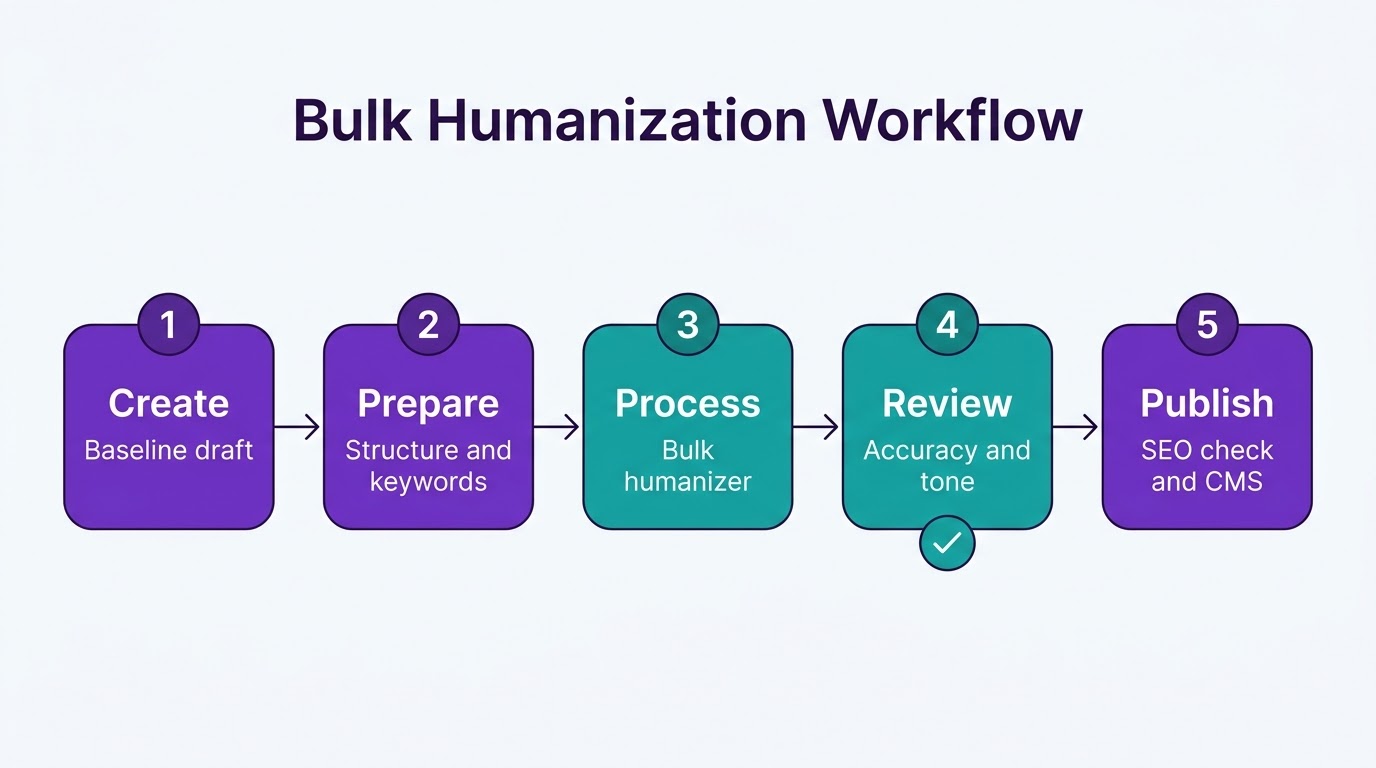
Using an API for bulk humanization can be particularly valuable for organizations managing hundreds or thousands of articles.
However, proper checks and safeguards should be in place. Consider content quality, data security, processing errors, and human approval before publication.
Automation should improve efficiency without removing important quality-control stages.
Step 5: Keep Humans in the Editorial Pipeline
One of the most important principles of batch processing AI text is that automated tools should complement human writers and editors, not replace them.
A bulk humanizer can improve wording and make content sound more natural, but it cannot guarantee that every statement is factually correct or appropriate for a specialized subject.
An article writer should remain responsible for fact-checking and making sure the information is accurate and comprehensive. At the same time, an editor should review the language, flow, structure, and overall suitability for the intended audience.
AI tools can handle basic text processing, but they may not recognize complex problems such as incorrect terminology in a highly specialized field.
Human oversight therefore remains an essential part of the editorial pipeline.
The Benefits of Scaling Content Production
A structured bulk workflow can help businesses scale content production without increasing repetitive manual work at the same rate.
For agencies and large content teams, this is especially useful when managing a high number of articles across multiple websites and clients. Our post on how to scale blog production with AI humanizers without losing quality goes deeper on this.
Instead of processing every article individually, teams can organize similar content into batches and apply standardized procedures.
| Efficiency Benefit | Impact on Content Team Operations |
|---|---|
| Reduced Repetitive Editing | Eliminates manual rewrites of standard AI patterns |
| Improved Workflow Consistency | Standardizes voice across large batches |
| Faster Processing Times | Handles large volumes of text in minimal time |
| Organized Operations | Categorizes content easily by client or website |
| Optimized Editorial Roles | Gives editors more time for high-value strategic tasks |
The key is to use automation strategically while keeping editorial standards in place.
Common Mistakes in Bulk AI Humanization
When humanizing content at scale, several common mistakes can hurt the production process and the quality of the final content:
- Not reviewing the original AI text: Some teams use a bulk text humanizer without reviewing the original AI-generated draft. Low-quality content then gets processed without fixing its underlying problems. Always review the source content before starting batch processing.
- Over-automating the process: Automation can save time, but there are limits to what a bulk humanizer can do. Some tasks require human judgment, particularly fact-checking, contextual editing, and judging whether the content meets the needs of its audience. At minimum, include a quality-control review after AI processing.
- Ignoring brand voice and requirements: Different clients and websites have different requirements. Avoid applying exactly the same instructions to every piece of content when the articles belong to different brands or website sections. Each batch should follow the right brand voice and editorial guidelines.
- Getting too caught up in AI detection: Content teams may become overly focused on AI detection results. The primary goal should be accurate, relevant, useful, and readable content. Instead of focusing only on detection scores, prioritize content quality, originality, relevance, and natural flow.
- Skipping the final round of edits: Even after bulk processing and editorial review, a final editing stage is valuable before content goes for approval or publication. A last review can catch small errors, formatting problems, awkward sentences, or inconsistencies that were missed earlier.
Content Production Workflows
A Sample Content Production Workflow for Teams and Agencies
A practical workflow for teams and agencies may include:
- Create: Write or receive the initial draft using research and AI tools.
- Prepare: Review the research, structure, search intent, and keyword usage.
- Process: Use a text humanizer to make the content sound more natural.
- Review: Evaluate the article from an editorial perspective.
- Approve: Complete the final quality and SEO checks.
- Publish: Submit the approved content to the CMS.
This workflow works for different types of content, including articles, blog posts, product descriptions, and email copy. Teams can also add new stages as their content operations become more sophisticated. See how content agencies use AI humanizers in 2026 for real examples.
A Sample Bulk Humanization Workflow for Text Articles
For teams focused on bulk humanization, the process can be simplified into five stages:
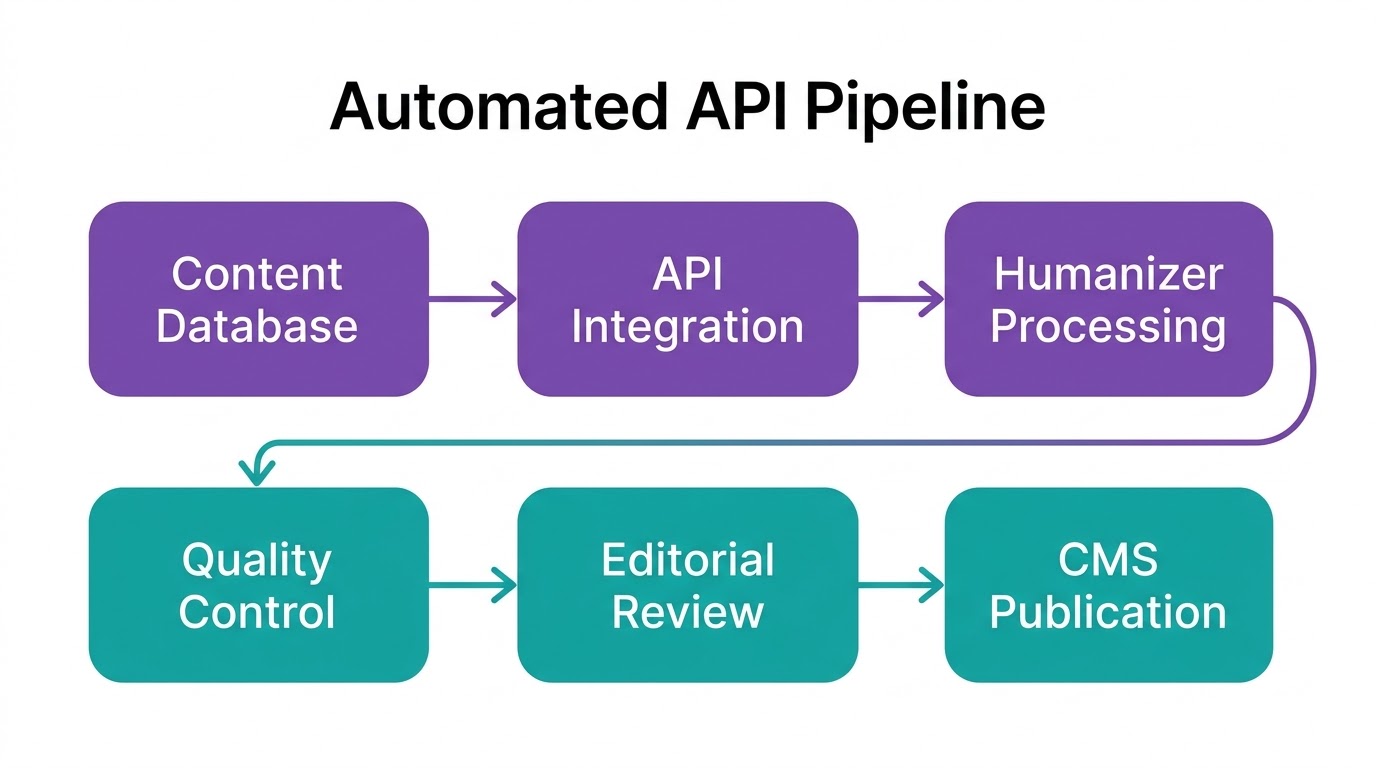
The exact process will vary depending on the requirements of each content team and client. However, a repeatable workflow gives everyone a clear framework to follow.
Conclusion
A bulk AI text humanizer can be a valuable part of a modern content production system, especially for teams and agencies that need to process large volumes of AI-generated content.
However, successful bulk humanization is not about processing as many articles as possible. Teams need a clear content team workflow, standardized editorial requirements, sensible batch organization, and reliable human oversight.
By combining batch processing, human editing, SEO optimization, and quality control, organizations can improve the efficiency of their content operations while keeping editorial standards high. If you are still comparing tools, see our list of the best AI humanizers.
Whether a team wants to humanize multiple articles or build a larger system through humanizer API integration, automation should support writers and editors, not replace them.
In the end, the real value of bulk humanization comes from a balanced workflow in which technology handles repetitive tasks while human professionals stay responsible for accuracy, context, quality, and the final reader experience.
Keep reading

Free vs Paid AI Humanizer 2026 Comparison: Is the Upgrade a Wise Purchase?
Compare Free vs Paid AI Humanizers in 2026. Explore pricing structures, bypass rates, feature differences, and discover if an upgrade is worth it.

How to Humanize AI Content for Online Course Creators
Learn how to humanize AI content for your online courses. Use a 4-step framework to turn robotic lesson drafts into warm, engaging teaching material.