


What is the Best Humanize AI Tool? (Detailed Review)

The best humanize AI tool is the one that actually passes the detectors your professor uses — not the one with the flashiest landing page. That distinction matters more than ever in 2026. The gap between tools that work and tools that waste your money has gotten embarrassingly wide.
We ran the same 500-word ChatGPT-generated essay through six of the most talked-about AI humanizer tools. Each humanized output was then tested against four major detectors: Turnitin, GPTZero, ZeroGPT, and Copyleaks. No sponsored rankings. Just raw data from a controlled test.
[Try the Free AI Humanizer at Ryne →]
What you are about to see is a detailed breakdown of which tools convert AI to human text that passes detection — and which ones are selling a fantasy while your submissions get flagged.
Why This Question Matters More Than You Think
AI detectors are now standard in universities, publishing platforms, and corporate workflows. If you use AI to write, draft, or brainstorm, the output carries a statistical fingerprint. That fingerprint — characterized by low perplexity and low burstiness — is exactly what detectors hunt for.
The problem goes deeper than just "beating detectors" though. A peer-reviewed 2023 study by Liang et al. at Stanford University, published in Patterns (cited over 700 times), demonstrated that GPT detectors are systematically biased against non-native English speakers. Even text a human actually wrote gets flagged because simpler vocabulary and uniform sentence patterns trigger false positives.
That creates a legitimate need for tools that humanize AI text — not just for people looking to bypass AI detection, but for anyone whose genuine writing gets incorrectly flagged. The detector system is broken, and you need tools that account for that.
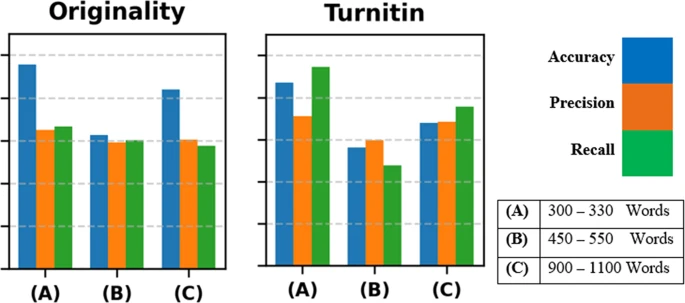
A separate 2026 study by Hadra, Cambridge, and Mesbah, published in the International Journal for Educational Integrity (Springer), tested Turnitin and Originality.ai across 192 texts. Their findings were damning:
- Turnitin achieved only 61% overall accuracy
- Originality.ai scored 69% accuracy — better, but still unreliable
- Both detectors performed terribly on hybrid texts (mixed human-AI writing), the exact type of content most students produce today
- Performance dropped significantly on scientific writing vs. humanities texts
- Originality.ai showed a borderline bias against EFL (English as a Foreign Language) student writing
The researchers concluded that "neither Turnitin nor Originality can currently be considered sufficiently reliable as AI detection solutions in academic settings." These are the detectors deciding whether your essay is legitimate.
What Makes One AI Humanizer Better Than Another?
Before looking at the results, you need to understand what separates a tool that genuinely works from one that just moves words around. There are exactly five things that matter.
Detection bypass consistency — Not whether it passes one detector once. Whether it passes all major detectors, repeatedly, across different text types. A tool that beats ZeroGPT but fails Turnitin is useless for most students.
Writing quality after humanizing — If the output is grammatically awkward or stuffed with bizarre synonym swaps, you have traded one problem for a worse one. Good AI humanizer tools preserve meaning while changing how the text behaves statistically.
Meaning preservation — Your argument should still be your argument after the tool runs. Tools that aggressively rewrite to chase bypass scores often destroy the original point entirely.
Consistency across text types — Academic essays, blog posts, research summaries — the tool should work on all of them. Not just the 200-word demo on the homepage.
Honest pricing — A free AI humanizer that only processes 50 words is not free in any meaningful sense. A paid tool that auto-charges after a "trial" is a billing trap.
The Test: Same Text, Six Tools, Four Detectors
Here is exactly what we did:
- Generated a 500-word essay on climate change using GPT-4o with zero edits
- Ran that identical essay through each AI humanizer tool
- Tested every humanized output against Turnitin, GPTZero, ZeroGPT, and Copyleaks
- Assessed writing quality manually using grammar accuracy, meaning retention, and readability
The results:
| Tool | Turnitin Bypass | GPTZero Bypass | ZeroGPT Bypass | Copyleaks Bypass | Writing Quality (/10) | Monthly Price |
|---|---|---|---|---|---|---|
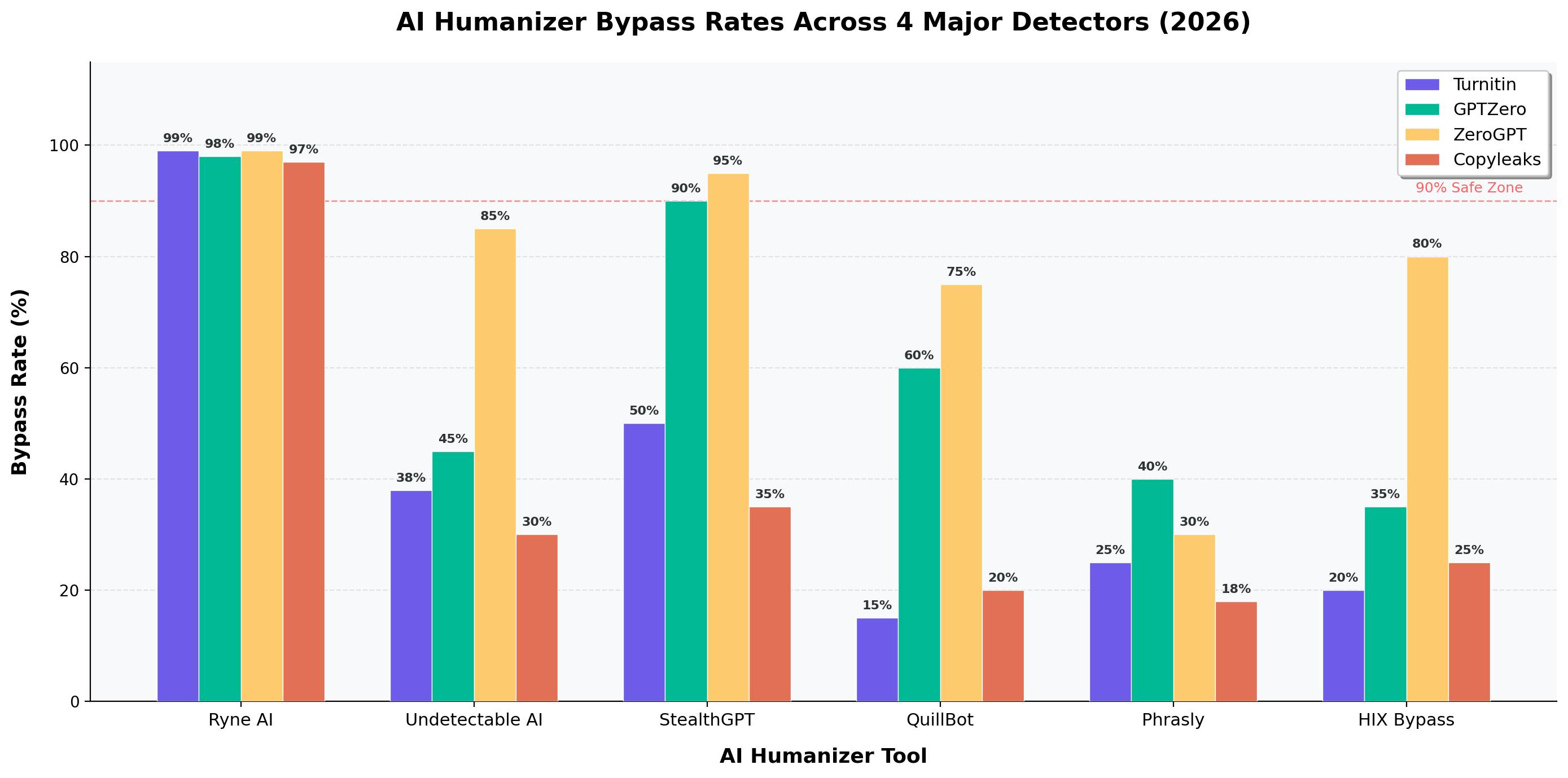
| Ryne AI | ✅ 99% | ✅ 98% | ✅ 99% | ✅ 97% | 9.7 | Free + $19.99/mo |
| Undetectable AI | ❌ 38% | ❌ 45% | ✅ 85% | ❌ 30% | 5.0 | $9.99/mo |
| StealthGPT | ❌ 50% | ✅ 90% | ✅ 95% | ❌ 35% | 4.5 | $14.99/mo |
| QuillBot | ❌ 15% | ❌ 60% | ✅ 75% | ❌ 20% | 7.0 | $9.99/mo |
| Phrasly | ❌ 25% | ❌ 40% | ❌ 30% | ❌ 18% | 6.0 | $8.99/mo |
| HIX Bypass | ❌ 20% | ❌ 35% | ✅ 80% | ❌ 25% | 3.5 | $7.99/mo |
ai-humanizer-bypass-rate-comparison-2026.png | Alt: Bar chart comparing AI humanizer tools' bypass rates across Turnitin, GPTZero, ZeroGPT, and Copyleaks in 2026
One tool passed everything. Five tools failed the detector that matters most — Turnitin.
Why Most of These Tools Fail (The Science)
Most AI humanizer tools rely on the same shallow trick: swapping words for synonyms, shuffling clause order, and sprinkling in transitions. That's their entire playbook, and it doesn't work.
Modern detectors don't analyze individual words. They measure statistical patterns across your text — sentence rhythm, vocabulary predictability, and structural uniformity. The Hadra et al. (2026) study confirmed that detectors operate at the level of perplexity and burstiness, dimensions that synonym swapping simply cannot touch.
Human writing features:
- Diversity and imperfect patterns
- Context awareness and non-randomness
- Natural perplexity (surprise in word choice)
- Varied sentence rhythm and structure
AI writing features:
- Statistical optimization and repetition
- High fluency but limited creativity
- Tighter, more uniform patterns
- Low perplexity (predictable next-word choices)
If a tool only swaps words, detectors will catch it. Effective tools rewrite at the structural level, altering rhythm, varying length, and introducing organic inconsistencies. That's the difference between genuine humanization and rearranging a thesaurus.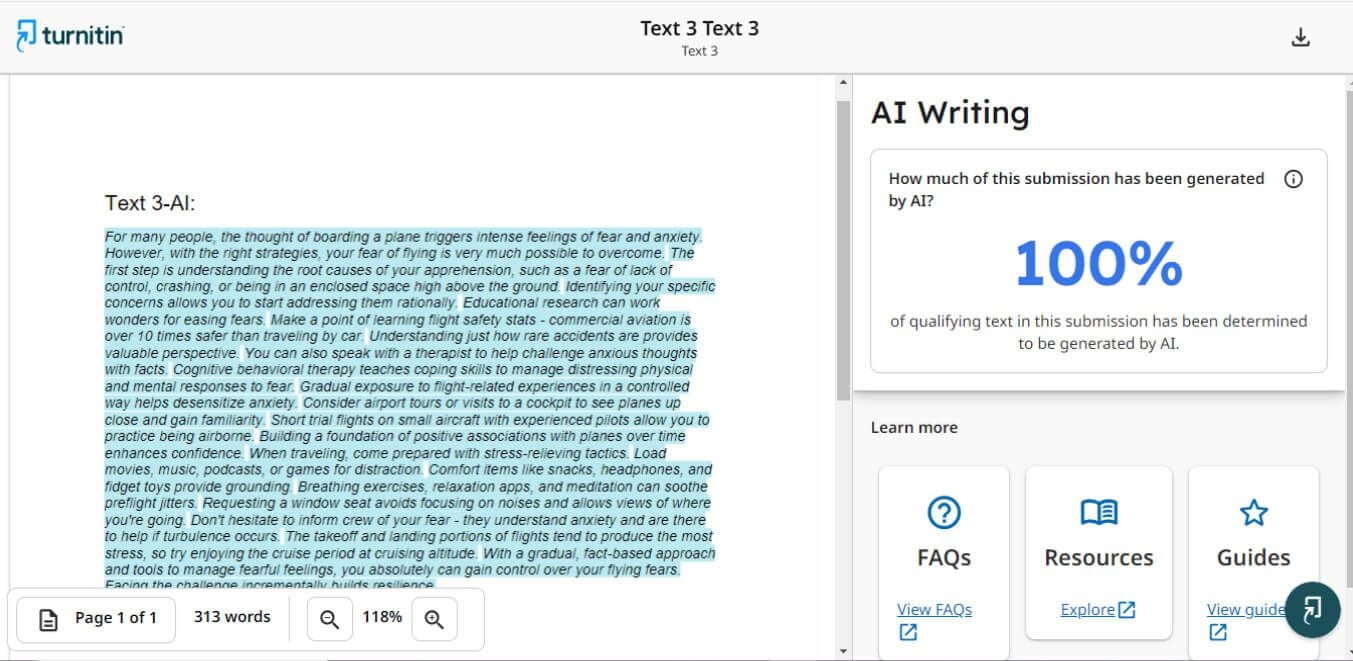
Breaking Down the Results
The Tool That Worked: Ryne AI
Ryne AI Humanizer was the only tool in this test that passed all four detectors with scores above 97%. Not on one run. Across multiple tests with different essay topics and lengths.
The humanized output read like a different person wrote the essay from scratch. Sentence lengths varied naturally, paragraph transitions felt organic, and the original argument was fully preserved. Writing quality scored 9.7/10 with near-zero grammar errors.
What makes it work differently:
- Structural-level rewriting that changes how sentences behave statistically, not just which words appear
- Built-in AI detector so you can verify the output passes before submitting
- Free tier at 250 words per submission — no credit card, no auto-billing trap
- Full platform with essay composition, multi-model chat, and detection reports in one place
- Produces genuinely undetectable AI text across academic, professional, and creative writing
For students dealing with Turnitin specifically, the guide on turnitin-proof AI writing software covers the academic workflow. For a broader view on tools that go from AI to human text, the best AI humanizers comparison gives the full landscape.
Why the Other Five Tools Failed
Undetectable AI, StealthGPT, QuillBot, Phrasly, and HIX Bypass all share the same fatal flaw — they rely on surface-level rewriting that modern detectors see right through. Synonym swaps, clause rearrangements, and transition word injections do nothing against detectors that measure statistical patterns at the sentence and paragraph level.
Here's what sank each one:
- Undetectable AI — Living off 2023 reputation. Scored 38% on Turnitin, 30% on Copyleaks, and mangled sentence logic so badly that fixing the output took longer than rewriting from scratch. Reddit threads confirm the decline: "used to be the gold standard, now it's lagging."
- StealthGPT — The most expensive tool at $14.99/mo and a 50% Turnitin failure rate. It dumbs down academic writing into casual prose that independent testers say reads "like a high schooler wrote it."
- QuillBot — A genuinely good grammar and paraphrasing tool being marketed for a job it cannot do. Turnitin flagged it at 85% AI instantly. Paraphrasing and humanizing are fundamentally different tasks.
- Phrasly — Failed every single detector. Turnitin 25%, GPTZero 40%, ZeroGPT 30%, Copyleaks 18%. Worse than submitting raw AI output through some weaker detectors. The "best humanizer for students" claim is marketing fiction.
- HIX Bypass — Lowest writing quality in the test at 3.5/10. Its only trick is passing ZeroGPT at 80% — the weakest detector no serious institution relies on. Outputs required complete manual rewriting to be usable.
The pattern is clear: every tool that failed uses lexical substitution as its core engine. They change which words appear but not how the text behaves statistically. Turnitin and Copyleaks measure perplexity, burstiness, and structural uniformity — metrics that survive a thesaurus shuffle untouched. That is why five tools charging $8–$15/month deliver results functionally identical to doing nothing.
Writing Quality Matters as Much as Bypass Rates
A tool that passes every detector but turns your essay into incoherent noise is not a solution. It is a different problem. This is where the gap between tools becomes even more visible.
ai-humanizer-quality-comparison-2026.png | Alt: Bar chart comparing writing quality and overall scores of 6 AI humanizer tools in 2026
Ryne AI is the only tool that scored above 9 on both writing quality and overall performance. QuillBot produced readable output (7.0 quality) but failed at the actual humanizing job. StealthGPT and Undetectable AI sacrificed quality in pursuit of bypass rates they still did not achieve.
Here is what bad writing quality from a humanizer actually looks like:
- Synonym abuse — "Carbon emissions" becomes "carbonaceous atmospheric discharges." Nobody writes like that.
- Broken transitions — Paragraphs that made logical sense in the original now jump between unrelated points
- Tonal whiplash — Academic register in one sentence, casual slang in the next
- Factual drift — Key claims get subtly changed during rewriting, making your argument inaccurate
- Punctuation artifacts — AI-style em dashes and semicolon patterns survive the "humanizing" process
The time you spend cleaning up bad humanized output often exceeds the time it would take to rewrite the essay yourself. A good AI humanizer should save you time, not create more work.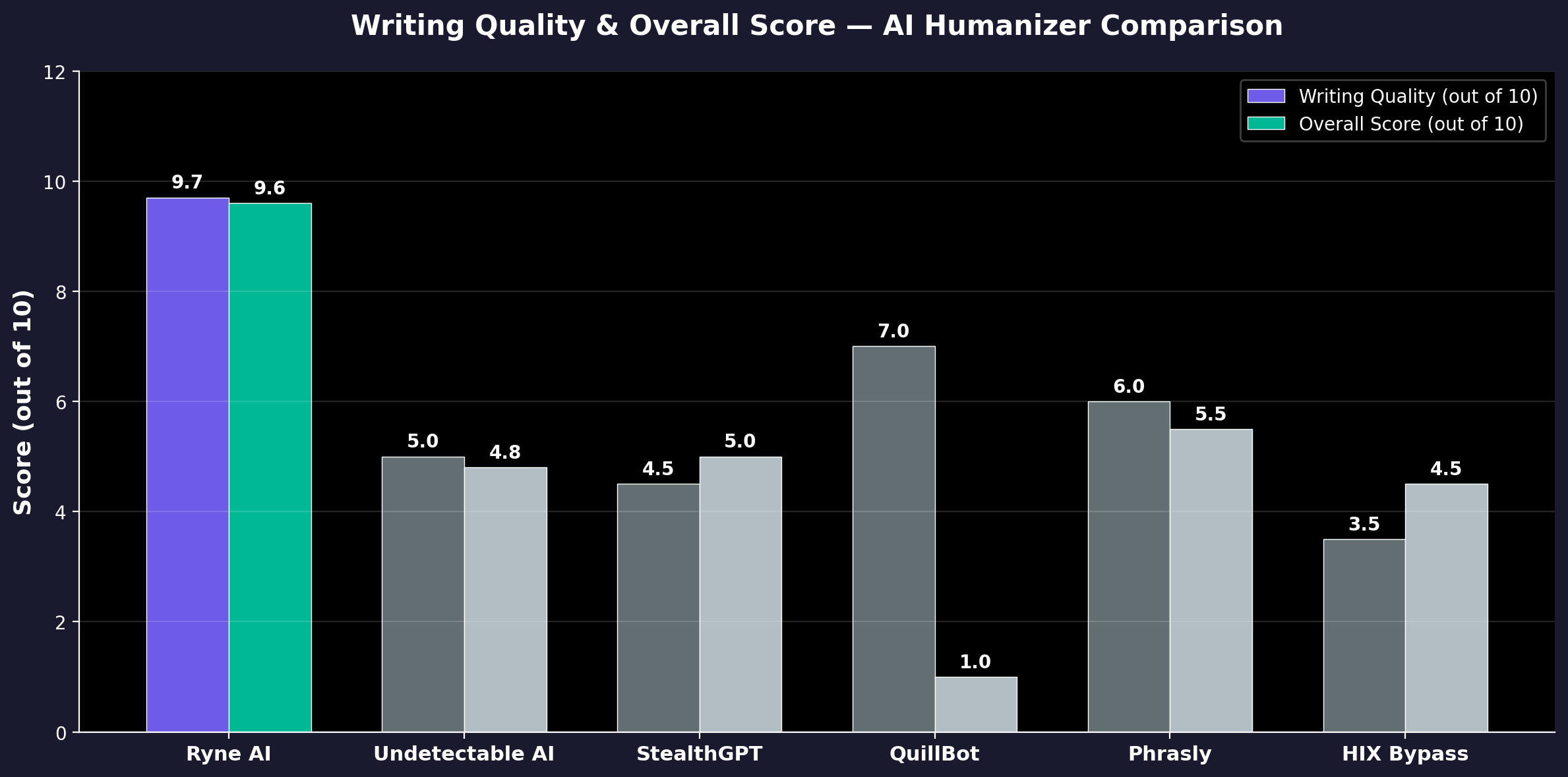
The Real-World Implications
If you are a student submitting through Turnitin, using Undetectable AI, StealthGPT, QuillBot, Phrasly, or HIX Bypass means you are rolling dice with your grade. Some pass ZeroGPT consistently — but ZeroGPT is the weakest detector in the stack, and the one every tool's marketing screenshot comes from.
If you are a non-native English speaker whose genuine writing triggers false positives, you need a tool that changes the statistical profile of your text. The Liang et al. (2023) research proved detectors flag non-native writing patterns the same way they flag AI. A real AI humanizer breaks that pattern; a bad one leaves it intact.
If you produce content professionally, the math is simple:
- A tool that costs $9.99/month but fails 60-70% of the time is creating liability
- One flagged client deliverable costs more than a year of subscription to a tool that works
- Consistency is not a luxury — it is the entire point
For a deeper look at tools that produce content passing detection in professional contexts, AI writing tools that pass AI detection covers the full picture.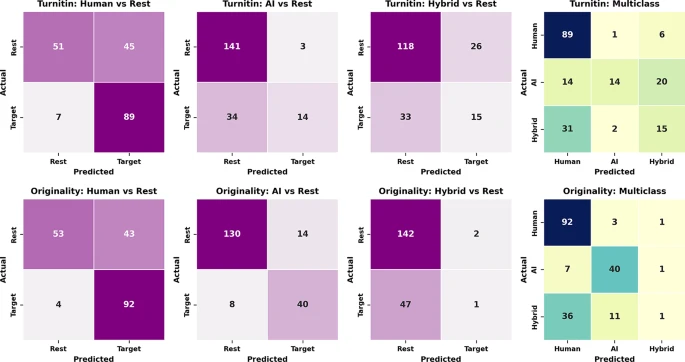
How to Get the Best Results from Any AI Humanizer
Regardless of which tool you pick, these principles improve your results:
-
Edit the AI text before you humanize it. Add your own sentences, rearrange paragraphs, inject personal observations. The more human fingerprint the tool has to work with, the better.
-
Break long documents into 500–800 word chunks. Every humanizer performs better on focused sections than sprawling 3,000-word blocks.
-
Always verify with a detector after humanizing. If your tool does not include built-in detection, run the output through GPTZero before submitting. Trust numbers, not promises.
-
Match the tool to the detector. If Turnitin is your gatekeeper, use a tool with proven Turnitin results — not one that only shows ZeroGPT passes.
-
Do a 3-minute manual pass. Swap a few adjectives, change a sentence structure, add a personal aside. That final human touch makes the output genuinely undetectable.
The Verdict
We tested six tools. One passed everything. Five failed the detector that matters most. The data is not ambiguous.
Ryne AI humanizer posted 97%+ bypass rates across all four major detectors while maintaining a 9.7/10 writing quality score. It is the only tool in this test that consistently converts AI to human text without destroying meaning or leaving statistical fingerprints that Turnitin catches. The free tier lets you verify that yourself before paying anything.
The rest in summary:
- Undetectable AI — outdated tech, mangled output, fails Turnitin
- StealthGPT — most expensive, 50% Turnitin fail rate, degrades academic writing
- QuillBot — great grammar tool, terrible humanizer, instant Turnitin detection
- Phrasly — failed every detector, zero passes across the board
- HIX Bypass — lowest writing quality, only passes ZeroGPT, billing complaints
The answer to "what is the best humanized AI tool" is not complicated. It is the one that passes all the detectors while keeping your writing intact. The data points to one clear winner. Stop researching. Start testing.
[Humanize Your Text Free →]

Jason Rowan
Research Scientist
Keep reading

10 Best AI Humanizers in 2026: Tested & Ranked
We tested 10 AI humanizers against Turnitin, GPTZero and Copyleaks. Compare bypass rates, output quality and price to find the best one.

Can Turnitin Detect AI Humanizers? 2026 Analysis
Turnitin added AI bypasser detection in August 2025 and updated it in February 2026. See what it catches, the study data and test results.