


AI Humanized Content vs Human-Written: Which Ranks Higher on Google?

Is content created by AI more likely to rank than human-made content? The debate between AI content vs human content ranking abilities on Google has stirred up quite the controversy.
As businesses have been using newer and better AI technologies to create articles, seasoned writers have stressed the importance of originality, expertise, and authenticity. It is no surprise that many are curious as to what is actually more likely to rank.
The surprising truth is that Google does not reward or punish based on the content creation method used to design the article. Rather, it penalizes pages that do not satisfy intent and rewards those that deliver high-quality content.
The most successful articles tend to combine both AI and human creation to achieve better efficiency and quality.
Google’s stance on AI content
Google’s emphasis on quality over creation method
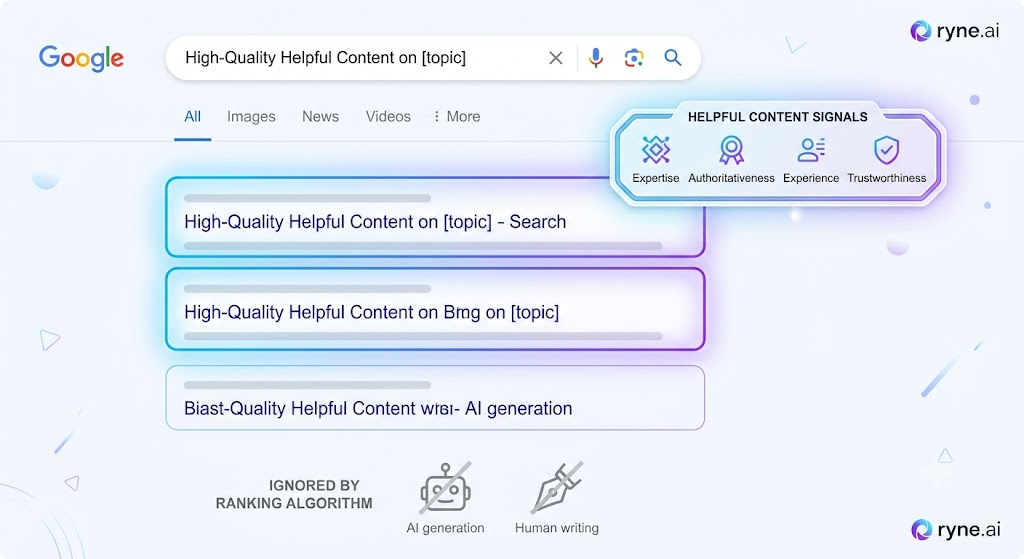
Google has made it very clear that they care more about helpful content than the method of creation. This means that pages will be rewarded based on their ability to satisfy intent rather than whether or not the information came from an AI or human writer.
Google’s helpful content guidelines have stressed the importance of creating information that is intended to be useful to their users. In fact, the Helpful Content system encourages creators to ignore the temptation of trying to appeal directly to search engines by prioritizing readers over algorithms.
This also means that businesses should not stress over whether or not to use AI to write their articles. They should instead focus on creating information that is relevant, original, readable and accurate while strengthening important content quality signals.
Helpful content and the E-E-A-T concept
Google guidelines on “helpful content” stipulate that the content provided must be informative and beneficial to the reader. As such, it needs to be created with an emphasis on Experience, Expertise, Authoritativeness, and Trustworthiness, otherwise known as E-E-A-T.
In other words, the article should be created in a manner that makes it appear as if it was written by someone who actually knows something about the subject they are writing about. While AI articles cannot demonstrate much E-E-A-T, experienced editors can add their own expertise, opinions, research, and analysis to improve the E-E-A-T of the final work.
This means that businesses should be utilizing AI and human writers together to ensure their articles are optimized for Google’s standards. In fact, this combination is what leads to the best balance of efficiency and authenticity. Rather than relying on one or the other, businesses should utilize AI as a tool while still using human writers to add their own flare, strengthening human written content SEO.
Humanizing AI content, and why businesses are doing it
Overview of AI humanization
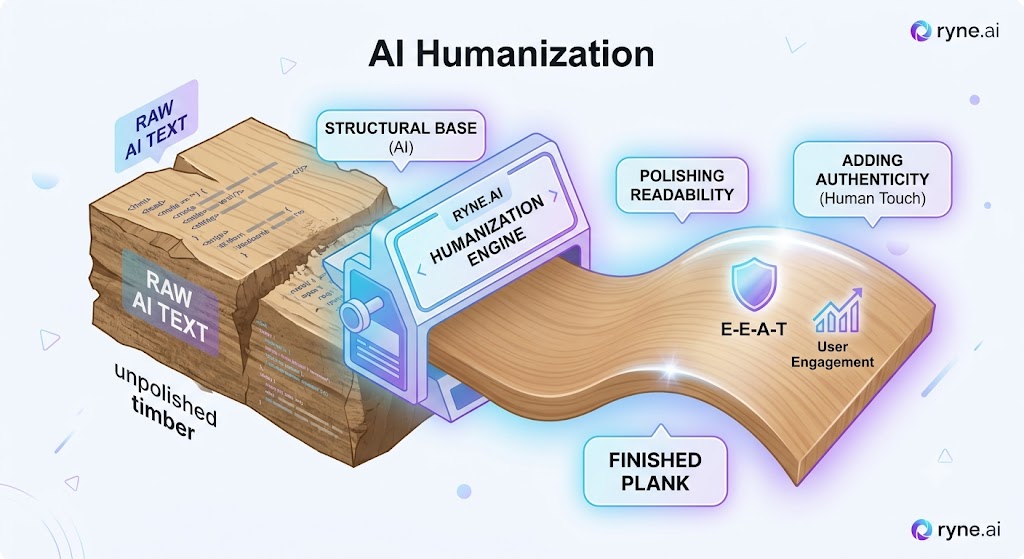
AI humanization is the process of editing AI content for a more natural appearance and feel. This might include paraphrasing or other similar methods to make the text more interesting or easier to digest.
In other words, anything that will make the article sound less like something generated by a computer. The process is similar to a contractor sanding and finishing rough lumber to create smooth boards for a house.
Much like how rough lumber can be useful, raw AI text can be very useful. However, in order to achieve the best result, both the natural timber and AI-generated text must be finished and perfected by a professional.
Why are businesses humanizing AI content?
Businesses are humanizing AI content because they need to optimize their content for both speed and quality. Humanizing AI content is crucial for businesses that want to scale their content marketing operations while maintaining high-quality and authentic content.
By implementing humanization, companies can offload some of the less desirable writing tasks to AI, while focusing their human writers on more important tasks. This can have a major impact on both the quality and quantity of content produced.
Additionally, humanizing AI content can help businesses appear more authentic, as many readers are unable to distinguish between human and AI-generated text. Additionally, businesses that use humanized AI articles can achieve faster production rates while still satisfying Google’s high-quality standards.
Human-made content, and its strengths
Overview of human-generated content writing
Humans have had the capability of writing since the beginning of time, with cave paintings being some of the earliest examples of writing found to date. Human-generated content writing is a process of producing information using individuals and not artificial intelligence for digital media such as websites or blogs.
Human brains are capable of portraying information and ideas more efficiently than any AI can, which is why they are so valuable in the writing process. Also, people can use their knowledge and expertise to produce articles that make the audience trust the brand behind it, therefore it is easier to sell products and services.
Most companies choose this method because it creates a better perception of the information the brand is portraying. It allows them to connect to the audience more efficiently through engaging articles, making human written content SEO an important advantage.
When and why is human content better than AI content?
I believe human content is better than AI content in certain scenarios. For instance, content should be human written if the information needs to have some level of creativity, engagement, or uniqueness to it.
AI generated articles would be more simple minded since they would be focused on just providing answers to questions as efficiently as possible. It would make articles less engaging, but more trustworthy.
| ✅ Human Content Strengths | ❌ Pure AI Content Limits |
|---|---|
| High creativity, engagement, and unique voice | Simple-minded focus on answering basic queries |
| Ability to turn dry topics into compelling reads | Lacks deep vertical expertise and practical nuance |
| Built-in E-E-A-T and personal authority signals | Sounds generic and mechanical without heavy editing |
Humans are also better at providing fresh, interesting takes on old or uninteresting subjects. Many people would find articles about the history of the internet to be boring, but a skilled writer would know how to add creativity and personality to an article so it is less dry, making the information more accessible to the general public.
Humans also bring a higher level of expertise to the table which can be difficult for AI to replicate, especially in verticals that require an in-depth understanding of the subject.
AI Content vs Human Content Ranking: What Do Recent Studies Say?
Ahrefs AI content study results
The Ahrefs AI content study revealed several important details about the relationship between AI-generated content and Google’s ranking system. It appears that AI content is everywhere, and it seems that it takes up a large amount of the top results on the search engine results page.
The results of the research suggested that many of the top domains utilize heavily AI text. This means that using AI content is not a penalty, which debunks some of the myths about articles written by artificial intelligence.
However, it does not necessarily mean you will rank higher on Google, as many people who used low-quality AI writing suffered a major blow to their rankings. This shows that Google favors articles that were well-written, regardless of their origin. This can either come from an experienced human writer or a combination of both AI and human writing.
AI content ranking correlation and additional data
AI content ranking correlation suggests that neither using AI nor avoiding it completely leads to higher rankings. The study suggests that there are several factors that influence search performance, and whether or not the article was created with AI is not one of them.
Rather articles tend to rank based on how much information they carry, the relevance and originality of the information, whether it is factual or not, and how easy it is to read. These findings are supported by available AI content performance data and show that these factors are much more important to Google than what method of article writing was used.
Content qualities Google values
Google tends to value content that performs better in terms of content quality rather than content volume. This implies that informative posts with relevant facts, appropriate formatting, and other aspects of organization have a greater chance of outranking other pieces of content.
This is because Google values brevity, relevance, and other content quality signals that help the audience in finding exactly what they are looking for. For example, articles that manage to succinctly offer solutions and answers to the problems posed by the reader will be more successful at SEO due to their ability to keep the audience engaged for longer periods of time.
User experience and search intent
User experience plays a significant role in Google rankings, as it is one of the main factors that determines how useful a particular page is to the users. Any article that is useful, relevant, and easy to use will inevitably improve a website’s rankings. This is because it keeps visitors on the page for longer time periods while simultaneously providing them with useful information.
As for search intent, it ultimately determines how well an article will perform, as it is the most important ranking factor that Google uses. Each written content should ideally cater to the search intent of the audience who are searching for it on Google.
This is because search intent is what defines the purpose for which the users are searching for particular queries on Google Search. Hence, it becomes crucial to optimize your article for the search intent it is supposed to fulfill.
Top ranking pages AI usage
As the Ahrefs AI content study found, the most popular sites tend to use a hybrid approach, combining human- and AI-written texts. Current top ranking pages AI usage trends show that companies which take this approach tend to use AI tools to generate articles faster and then rely on human editors to make the texts sound engaging and non-robotic.
Such an approach allows these companies to maintain a perfect balance of speed and quality. Therefore, it can be concluded that it is the best choice for companies that desire to create articles in a shorter amount of time yet still want to preserve the quality and user experience of the end product.
AI content detectors
Many website owners worry about the effects that AI content detection tools can have on their website's online presence and visibility. The truth is that these detectors should have little to no effect on a business’s SEO efforts.
This is because Google does not publicly recognize these tools, and many of them tend to give conflicting results due to constant technological advancements. It is also worth noting that Google does not officially reward businesses for passing AI content detection tools, so there is little reason to actively try to optimize for them.
Strategies and best practices for ranking AI humanized content
Tips for maximizing AI humanized content
Many companies have been asking how they can maximize the potential of AI-humanized content. The reality is that the best way to do this is to utilize the combination of AI writing and human writing so that the process can be done right.
- Thorough Research: Ensure that the text generated by artificial intelligence has been thoroughly researched and written in such a way that it contains useful information, so that Google recognizes it as such.
- Formatting: Consider the formatting of your text since a presentation that is easy to read and appealing will help you reach a wider audience.
- SEO Optimization: Take into account how you are search engine optimizing your web content to be seen by your audience.
With the right approach, AI content vs human content ranking becomes less about the writing method and more about overall quality.
Common mistakes to avoid when optimizing AI content
There are many things that companies should avoid when optimizing AI content. For one, businesses must avoid publishing articles generated by AI software without human editing. In addition, companies should refrain from keyword stuffing in their articles because search engines have already penalized many websites for this unethical SEO practice and this tactic is no longer effective.
The future of AI and human content creation in SEO
AI-human collaboration vs competition
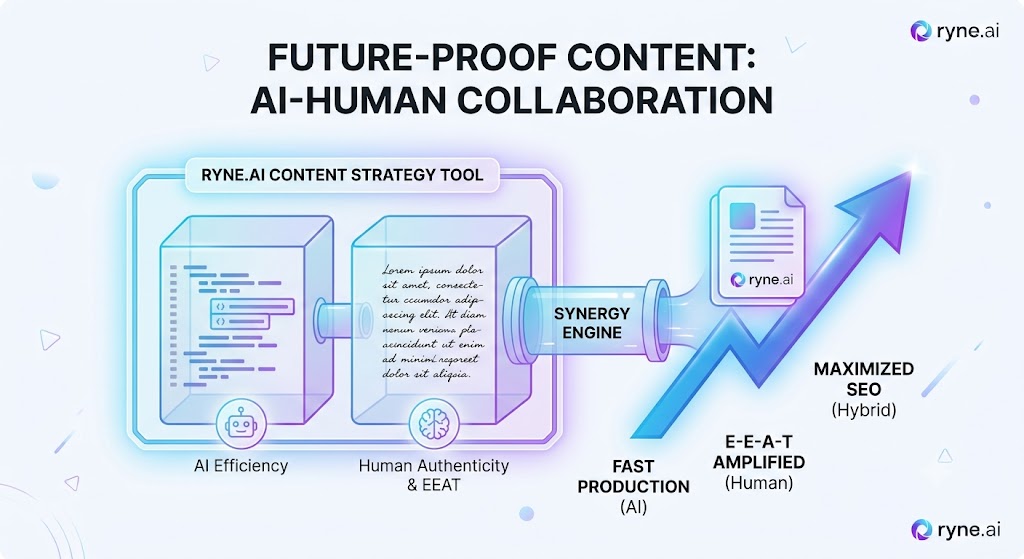
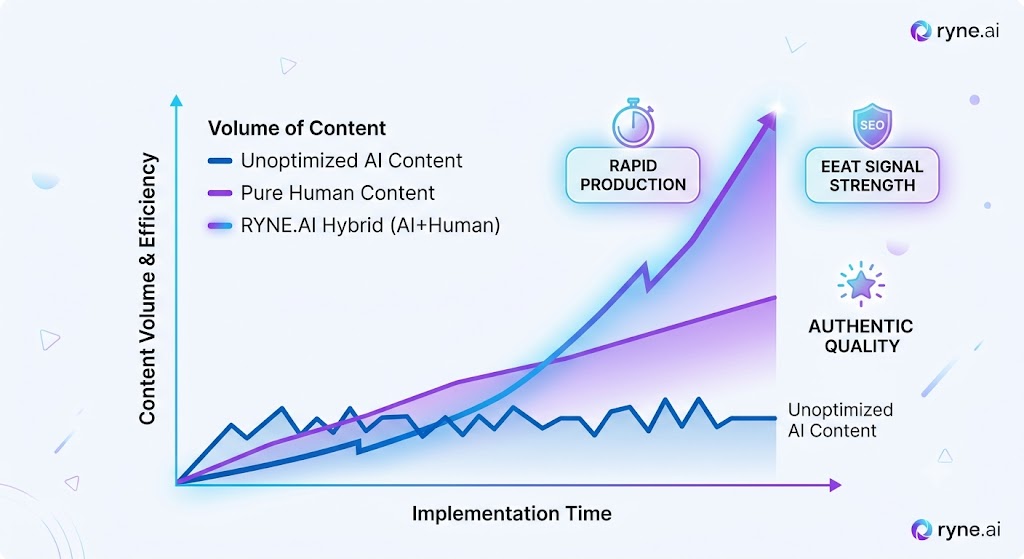
AI-human collaboration tends to be the most optimal choice for SEO purposes, as it provides businesses with a good balance between quality and quantity. AI-assisted content writing programs allow companies to write articles much faster than it would take them to write normally.
Meanwhile, human writers can provide the necessary expertise and opinions that AI systems are unable to incorporate. In the end, companies that use both forms of content creation often perform better in AI content vs human content ranking discussions because they benefit from both approaches.
Conclusion
AI-human debate: Is human content better than AI content?
The debate around AI content vs human content ranking shows no signs of slowing down anytime soon. As mentioned throughout this article, human content tends to have better SEO performance, particularly when it comes to Google rankings.
That being said, Google does not reward or punish based on whether or not the article was created by an AI. Instead, the search engine prioritizes helpful content, which means that businesses should strive to create content that satisfies the needs of their users rather than focusing on the content creation methods.
In fact, research from the Ahrefs AI content study and ongoing AI content ranking correlation findings show that companies managed to rank their AI-assisted articles by optimizing them for Google’s requirements.
Moreover, human-written texts are better in terms of authenticity, originality, and expertise, among other things. In this regard, it is necessary to use both AI-humanized content and human writings for maximizing SEO efficiency and improving AI content vs human content ranking results.
FAQs
1. Can AI content rank on Google?
AI content can rank on Google, as long as it satisfies Google’s requirements.
2. Does Google detect AI content?
Google does not officially recognize most AI content detection tools, so they usually have a minimal effect on your SEO score.
3. Is human content better than AI content?
In many cases, human content can be better than AI content because it can provide a better user experience while also satisfying Google’s requirements.
4. Should businesses use AI humanizers?
Businesses should use AI humanizers to enhance the quality, readability, and authenticity of their articles when needed.
5. What is the best SEO strategy in 2026?
The best SEO strategy in 2026 will continue to focus on content quality, with businesses using a combination of AI and human writing to improve their content creation process and strengthen AI content vs human content ranking.


AI Humanizers for Email Marketing: Boost Open Rates Without Sounding Robotic
Learn how AI humanizers for email marketing can transform generic, automated drafts into high-converting messages with higher open rates and inbox deliverability.

How to Maintain Brand Voice When Using an AI Humanizer at Scale
Learn how to maintain your unique brand voice when using AI humanizers at scale. Discover tips for brand playbooks, custom AI prompts, and multi-client workflows.