


How AI Study Assistants Transform Study Skills

Introduction: Why AI Study Assistants Matter Now
The way students study is broken. Let's be honest about it. They're cramming the night before exams. They're highlighting textbooks and pretending that's learning. They're memorizing facts without understanding concepts. And the system acts like this is normal.
Here's what's actually happening: AI Study Assistants are systematically dismantling this broken approach. Not with promises—with measurable, documented results that transform how students study, what they retain, and how well they perform. These AI homework helpers and exam preparation tools aren't supplementary. They're transforming the entire foundation of learning.
The Study Skills Crisis: Why AI Study Assistants Beat Traditional Study Methods
The Problem With Outdated Study Techniques
Most students rely on study strategies they invented themselves or learned from older students. According to research on student learning behaviors, approximately 80% of undergraduates report that their study skills were learned on their own, not taught by teachers.
This means students are flying blind, using outdated study techniques and ineffective study methods that feel productive but deliver minimal results.
The dominant (and ineffective) strategies:
- Rereading textbooks—passive, low-impact, creates false sense of learning
- Highlighting passages—feels productive but doesn't build understanding
- Passive review—repetition without active engagement or personalized learning feedback
- Cramming—memorization without comprehension or learning strategies
- Generic note-taking—no personalized learning structure or academic performance improvement
The Cycle That Traps Students
This creates a vicious loop:
- Students study more → understand less
- Spend more time on homework → retain fewer concepts
- Feel stressed and overwhelmed → work harder without results
- System tells them to work harder → they cram more
- Burnout increases → grades suffer anyway
The irony: more effort produces worse results because the methods don't work. Students feel like failures when the system itself is the failure.
Enter AI Study Assistants: A Completely Different Learning Framework
How AI Study Assistants Transform Traditional Learning
AI Study Assistants operate on fundamentally different principles:
- Instead of passive review: Active retrieval through learning strategies that build retention
- Instead of generic plans: Personalized learning pathways and study techniques adapted to individual needs
- Instead of studying until burnout: Optimized efficiency through student performance analytics
- Instead of weeks waiting for feedback: Immediate correction with learning strategies that prevent errors
The research is unambiguous. A meta-analysis examining AI's effect on students' academic achievement across 29 empirical studies with 2,657 participants found a significant positive effect with an effect size of 0.924. That's not marginal improvement. That's fundamental shift.
Beyond Grades: The Real Transformation
But here's what separates real transformation from hype: it's not just about grades.
Research on AI-enhanced learning systems deployed to 1,002 biology students revealed that the most impactful elements were metacognitive requirements—mandatory confidence ratings and explanations for every question.
These drove substantial behavior changes:
- 82% of students reported increased confidence in academic performance
- Textbook engagement jumped to 40% (versus typical 27%) through improved study strategies
- Students transferred reflection strategies to future courses, building sustainable learning strategies
They didn't just learn material for one exam. They learned how to learn.
How AI Study Assistants Transform Study Skills: The Mechanics
1. Personalized Learning Pathways: Efficiency Through Data
Traditional education assumes all students learn the same way at the same pace. This one-size-fits-all approach to study techniques wastes time for some and frustrates others.
AI Study Assistants eliminate this through personalized learning pathways and adaptive study methods. These systems:
- Assess student performance in real-time
- Adapt content dynamically based on data
- Move students forward when they master concepts
- Provide targeted support when they struggle
- Identify specific learning gaps with precision
The benefit: Students spend study time on material they don't understand instead of reviewing already-mastered concepts. That's efficiency. That's time liberation.
2. Real-Time Feedback & Misconception Correction
Traditional assessment forces students to wait days or weeks for test results. By then, misconceptions are calcified. A student might misunderstand week one material and spend four weeks building false knowledge on that foundation.
AI Study Assistants deliver immediate feedback on every response. This isn't just "you're wrong." Quality systems:
- Explain why the answer is incorrect
- Clarify the concept being misunderstood
- Show how to approach the problem correctly
- Correct misconceptions before they become habits
The impact: A misconception caught in week one stays limited to week one instead of poisoning the next three weeks of learning.
3. Metacognitive Awareness: Learning How to Learn
Metacognition is knowing what you know. It's thinking about your own thinking. Most students have no awareness of their actual comprehension versus perceived comprehension. They think they understand something when they don't.
AI Study Assistants force metacognitive engagement by requiring students to:
- Rate their confidence on each response
- Explain their reasoning
- Evaluate their own performance
- Track learning progress over time
This builds actual learning skills, not just temporary memory.
The key insight: When students must articulate why they chose an answer, they reveal gaps in understanding they might otherwise miss. When they rate their confidence, they calibrate their self-assessment and become accurate judges of their own knowledge.
When students develop this metacognitive awareness, they often realize they understand concepts more deeply than they can express. Their thinking is clear, but their writing feels muddled. This is where Ryne's humanizer becomes invaluable. It converts complex thinking into clear, confident written expression without changing what students actually know.
4. Study Time Optimization: Better Results, Less Time
Research tracking student study habits found a significant reduction in study hours alongside an increase in GPA. Students weren't sacrificing performance by studying less. They were achieving better performance because they studied smarter.
When AI removes wasted time on low-impact techniques, students focus mental energy on deep learning instead of volume.
The math: A typical student spends eight hours "studying" with minimal retention. An AI-assisted student might spend five hours and achieve superior results because every minute targets genuine learning challenges. This isn't multitasking efficiency. This is fundamental optimization of how mental effort translates to learning outcomes.
The Data: What AI Study Assistants Actually Achieve
Adoption Rates Show Strong Student Confidence
The numbers tell a clear story:
- 95.6% of respondents use artificial intelligence technologies in academic activities
- 88.2% specifically use virtual assistants like ChatGPT for academic support
This represents mainstream adoption, not early adoption. This is how the majority of students now approach learning. They've made a collective choice: AI Study Assistants deliver results as exam preparation tools and homework helpers.
Mental Health & Stress Reduction
AI Study Assistants don't just improve grades. They improve student wellbeing.
Research from Frontiers in Psychology examining 401 Chinese university students found:
- Students perceive AI as having significant potential to improve mental well-being
- AI-powered chatbots and virtual assistants provide immediate support
- Mental health services become more accessible
- Stress associated with academic workloads decreases
Why this matters: Stress is the enemy of learning. When students feel supported and have immediate access to help, they perform better. They approach learning from confidence instead of panic.
Communication Clarity & Confidence
Research among 401 university faculty members in Business and Management fields found that adoption of AI Study Assistants:
- Increased overall happiness and reduced stress
- Improved communication efficiency
- Helped students articulate ideas more effectively in written form
- Promoted clarity in academic exchanges
This reveals something critical: AI Study Assistants help students communicate understanding, not just obtain it. Students sound more authoritative. They articulate arguments more effectively. They demonstrate mastery through confident communication.
AI Study Assistants Transform Study Skills: What Actually Changes
Before Using AI Study Assistants
Traditional student experience includes:
- Passive studying (reading, highlighting, memorizing without understanding)
- No personalized feedback, just generic materials
- Waiting weeks for grades (misconceptions become entrenched)
- Accumulated stress from "working hard" without results
- No clear strategy or learning framework
- Uncertainty about what you actually understand
After Implementing AI Study Assistants
Pre-Study Planning:
Students identify specific learning objectives, assess current knowledge level, and select targeted strategies based on data. No more guessing. No more wasted time.
Active Engagement During Study:
Students actively retrieve information, explain concepts aloud or in writing, and engage directly with AI feedback. This active practice builds stronger long-term retention than passive reading ever could.
Immediate Correction:
Misconceptions are caught immediately. Students understand why their thinking was wrong, practice the correct approach, and eliminate errors before they become ingrained habits.
Strategic Review:
Instead of random rereading, students review only concepts they haven't mastered. They test themselves on borderline knowledge and focus effort where impact is highest. Wasted time disappears.
Transfer of Learning:
Students practice approaching new problem types using strategies they've learned. They recognize patterns across different subjects. They develop genuine problem-solving ability instead of just memorizing solutions.
Communication Mastery:
Once students build genuine understanding, they face a new challenge: expressing it powerfully. Many students think clearly but can't write clearly. Ryne's AI humanizer bridges this gap by converting expert thinking into expert writing:
- Transform hedging language into confident statements
- Replace passive voice with active authority
- Write with the confidence their knowledge deserves
- Present mastery instead of uncertainty

From Learning to Communication: The Complete Transformation
The transformation doesn't stop at understanding. It includes how students communicate what they've learned.
A student might have brilliant insights and deep conceptual mastery, but if they can't express it in writing that sounds authoritative, that mastery gets lost in translation.
The Three-Stage Learning Process
Stage 1: Build Understanding
Use AI Study Assistants to identify learning gaps, engage with personalized content, receive immediate feedback, and build genuine comprehension. Develop metacognitive awareness and learn how to learn.
Stage 2: Practice Communication
Develop voice and authority in writing. Recognize which ideas communicate powerfully and which need refinement. Begin expressing mastery through written work.
Stage 3: Master Expression
Use Ryne's Humanizer to transform academic writing—converting stiff, uncertain prose into clear, confident communication. Ensure every assignment reflects your actual expertise.
Why This Complete Process Works
The combination of AI Study Assistants and Ryne's AI humanizer creates comprehensive learning transformation. Students build understanding through active, personalized study, then convert that understanding into powerful written expression.
The result:
- Students who don't just learn better, but communicate better
- Assignments that reflect actual expertise
- Written work that demonstrates mastery instead of uncertainty
- Better grades from genuine understanding and clear expression
This is what separates A students from B students even when actual understanding is similar. Mastery requires both deep learning and powerful communication.
The Resistance: Why Some Still Cling to Broken Systems
Legitimate Concerns That Deserve Serious Engagement
Some resistance to AI Study Assistants is justified:
- Concern about over-reliance on technology
- Worry that students won't develop independent critical thinking
- Questions about data privacy
- Need for proper implementation frameworks
These are valid concerns deserving serious implementation strategies and thoughtful oversight.
Ideological Resistance: The Real Problem
But some resistance is just inertia:
- "This is how we've always done it"
- "Students need to struggle to really learn"
- "Real learning happens through suffering"
These aren't educational principles. They're excuses for avoiding change. They're the rhetoric of people defending broken systems.
The brutal truth: If your study system requires suffering and produces mediocre results, your system is failing. If a different approach produces better results with less suffering, the better approach wins. This is natural selection in education. Ideology loses to results.
Students who adopt AI Study Assistants systematically outperform students who don't:
- Study less
- Understand more
- Retain better
- Apply more effectively

Building the Foundation: How to Actually Use AI Study Assistants Effectively
The Critical Principle: Intentionality
Using AI Study Assistants effectively isn't automatic. Just like having a gym membership doesn't make you fit, having access to an AI Study Assistant doesn't guarantee transformation.
Students must approach AI Study Assistants with intentionality:
- Use them as tools for active learning, not shortcuts replacing thinking
- Engage with feedback rather than just reading it
- Explain your reasoning rather than just inputting answers
- Track progress and identify remaining gaps
- Transfer strategies to new learning situations
The Simple Framework That Produces Results
Follow this sequence:
- Use AI to identify learning gaps
- Engage with content to close those gaps
- Receive immediate feedback to verify understanding
- Reflect on your thinking process
- Repeat until mastery
This structure produces transformation when followed consistently.
Completing the Cycle: From Mastery to Communication
After mastering content through rigorous study using AI Study Assistants, students often discover their writing doesn't match their thinking. Their arguments get buried under hesitant language. Their expertise gets obscured by passive phrasing.
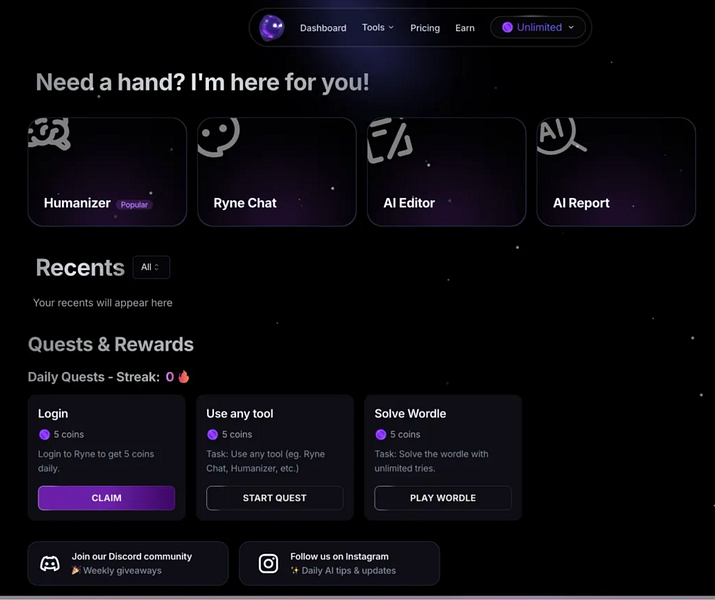
This is where Ryne's Free AI Humanizer completes the cycle. The humanizer transforms academic writing by converting stiff, uncertain prose into clear, confident communication.
It's not about changing what students know. It's about revealing what they know.
When a student invests effort to master material through AI Study Assistants, they deserve to present that mastery in writing reflecting their actual expertise.
The Future of Learning Is Here
This Is Already Happening
AI Study Assistants are already transforming how students learn, what they retain, and how they think about learning itself. The transformation is measurable, documented, and accelerating.
The question isn't whether this will happen. The question is participation.
Will you:
- Embrace tools that demonstrably improve learning outcomes?
- Take advantage of available resources to study smarter?
- Complete the full transformation from learning to powerful communication?
- Or watch your peers succeed while clinging to outdated methods?
Most Students Are Already Answering Yes
They're using these tools. They're achieving better results. They're moving past the broken study systems that held previous generations hostage.
Forward-thinking students aren't just using AI Study Assistants to learn. They're completing the full transformation:
- Build genuine understanding through AI Study Assistants
- Practice communicating expertise
- Use Ryne's humanizer to present mastery in writing
They're moving from:
- Struggling students using outdated techniques
- → Confident learners with genuine mastery
- → Clear communicators demonstrating mastery in every assignment
Your Choice
The students who recognize this and act on it will thrive. The ones who cling to traditional approaches will wonder why they're studying harder but learning less.
This is what transformation looks like:
- Better grades
- Deeper understanding
- Genuine mastery
- Confidence to communicate that mastery
- Reduced stress and increased wellbeing
Not promises. Results.


Walter Writes AI Review: Does It Actually Bypass Detection?
Walter Writes AI is currently failing Turnitin checks (Aug 2025). Looking for the best AI humanizer tool? If you need a safe alternative immediately, check Ryne AI.

How to Study with AI: Maximize Learning Efficiency
You're studying wrong. Most students are. They spend hours on textbooks, highlight passages, take notes nobody reads, and call it studying. Then they're shocked when results don't match the time invested.