


AI Humanizers for Medical Content: What's Safe and What Isn'

Why Is AI Transforming Medical Content Creation?
Medical professionals are producing more digital content than ever hospitals develop patient education materials, clinics design appointment instructions, pharmaceutical companies create informative articles, and medical marketers publish blog posts about health topics.
Artificial intelligence accelerates this process, but it cannot replace qualified professionals hence why an AI humanizer for medical writing is proving to be a valuable assistant.
It enables robotic-sounding AI content to appear natural and engaging for readability, but healthcare organizations must carefully consider what’s safe and unsafe to humanize while maintaining medical AI content safety.

Humanizing Medical Content AI’s Output Isn’t Always Straightforward
What Is An AI Humanizer For Medical Writing?
An AI humanizer for medical writing is used to revise artificial intelligence content to appear more natural and engaging for readability. It enables robotic-sounding sentences to appear fluid and less mechanical for patients, doctors, and medical marketers.
However, it’s often better to rely on medical expertise than generic paraphrasing tools when humanizing medical content. Effective humanization maintains context and meaning, not just form.
This is crucial for healthcare, as technical terminology shouldn’t be artificially altered. An AI humanizer is a great editorial assistant, but it shouldn’t be relied upon as a medical writer and this goes for all applications of an AI humanizer for medical writing.
How Can Humanizing Medical Content Make It More Accessible?
Medical content often overwhelms readers due to its complexity both in terms of medical terminology and dense writing style. An AI humanizer makes text easier to digest by restructuring sentences for improved flow, reducing repetitive phrasing common in AI content, and otherwise altering presentation.
This has clear benefits for patient education materials, as healthcare organizations want to encourage readers to finish an article rather than put it down due to difficulty understanding.
However, improved readability shouldn’t come at the expense of accuracy; every altered paragraph must still be reviewed by medical professionals to appear credible and publishable.
Why Can Humanizing Medical Content Benefit Healthcare?
Even the best AI cannot replace human insight when it comes to patient care but an AI humanizer for medical writing can help content appear more engaging while saving time spent editing.
Why AI Humanizers Benefit Patient Education Resources
Patient education materials should be written using plain language for non-medical individuals to understand the specific condition, procedure, treatment, or another issue.
An AI humanizer can make technical writing more understandable by rewording sentences, thus resulting in easy-to-read information containing all relevant medical details.
This is beneficial for patients because having easy-to-follow instructions after surgery is more likely to result in adherence to post-operative recommendations than a detailed and complex document.
Nevertheless, an organization should ensure the accuracy of the data, suggested dosages of medications, and other recommendations included in the patient education material.

Why AI Humanizers Are Useful For Clinical Documentation AI
Clinical documentation is increasingly relying on artificial intelligence to facilitate the production of discharge summaries by medical professionals working in healthcare settings during their shifts.
An AI humanizer can be used for medical writing to improve grammar and readability while ensuring that no information is changed, thus saving time spent on editing. Similarly, a humanizer is useful in the context of AI clinical notes.
However, medical professionals must not change any of the objective data related to the patient’s diagnoses, prescriptions, laboratory results, etc., as it raises the possibility of errors.
How Can Humanizing Medical Content Assist Internal Healthcare Communication?
Healthcare organizations often need to communicate with employees whether it’s policy overhauls, staff announcements, onboarding guides, or other documents.
An AI humanizer can make these materials less dry while still appearing professional and this has benefits for both healthcare organizations and their employees.
It allows organizations to share information clearly without boring workers, and it reduces time spent editing since AI writing tends to be repetitive and unnecessarily complex.
When Shouldn’t Healthcare Employers Use An AI Humanizer?
Despite its benefits, an AI humanizer shouldn’t be used for anything that requires clinical expertise. Medical professionals should always double-check altered content for accuracy, but AI-humanized text is never as reliable as something written by an experienced medical writer.
Medical Advice & Recommendations
Medical recommendations shouldn’t be published without a trusted professional’s approval. An AI humanizer for medical writing can improve readability, but it cannot guarantee that advice follows the latest standards of care or meets medical AI content safety expectations.
Research Paper Writing & Journal AI Disclosure Policy
Many journals now require articles to disclose where AI-assisted writing occurred, and healthcare organizations should always follow journal AI disclosure policy when submitting work.
An AI humanizer can make prose flow better, but it cannot offer the same level of scientific analysis as a trained researcher. Authors must always review journal AI disclosure policy guidelines and conduct their own fact-checking before publishing.
Regulatory Healthcare And Legal Healthcare Documents
Legal healthcare documents and regulatory submissions require extremely careful wording even small changes can create loopholes or ambiguities that lead to disputes. An AI humanizer shouldn’t be used for legal healthcare documents because minor alterations could compromise important language.
Why Medical Terminology Accuracy And Compliance Matters For Healthcare Organizations
Medical terminology is often complicated, so medical terminology accuracy is incredibly important for healthcare organizations. An AI humanizer shouldn’t be relied upon to simplify terms, instead prioritizing context over clarity.
Healthcare organizations must also ensure terminology follows regulatory requirements for instance, using officially recognized terms for specific treatments and drugs.
Maintaining medical terminology accuracy is part of healthcare content compliance, which has benefits for both organizations and patients.
This is especially crucial for medical writing, as incorrect terminology could appear unprofessional, undermine a patient’s trust in an organization, or lead to dangerously wrong assumptions about a medical condition.
Healthcare Content Writing Best Practices For AI Humanization
Healthcare content writing best practices remain the same, but an AI humanizer can assist with maintaining consistency while supporting healthcare content compliance and making prose less dry.
Why Medical Writers Need To Choose The Right Tools For Humanizing Content
Medical writers benefit from using an editor that makes the language less awkward but keeps everything consistent and contextual intact instead of having to rewrite the whole text later because doing otherwise is a tedious task for anyone and an unnecessary waste of time and effort that could have been avoided by simply using AI humanizer to make changes automatically.
When it comes to picking out the right tools for humanizing content, medical professionals need to think about how readable the text will be for people to read. For instance, many paraphrasing tools alter sentence structure too drastically, which makes writing appear unnecessarily complex.
Why Medical Writers Shouldn’t Rely On AI Alone
Anyone utilizing an AI humanizer for medical writing should understand that it shouldn’t be relied upon as a medical writer. This goes for medical terminology accuracy, editorial assistance, and everything else concerning healthcare content writing.
Even the most sophisticated AI can make mistakes, which is why healthcare professionals must always review content before publishing.
Why Medical Organizations Need To Follow Strict Editorial Guidelines When Humanizing AI Content
Health care institutions have strict guidelines when it comes to content publication, which is only normal in such a sensitive area. An AI humanizer for medical writing can both help meet the standards by eliminating clickbaityness and not make the article untrustworthy.
Organizations should use an AI humanizer for medical writing as a tool to support editorial guidelines, not replace them.
Why Ryne.ai Is Becoming A Popular Choice For Healthcare Content Writers
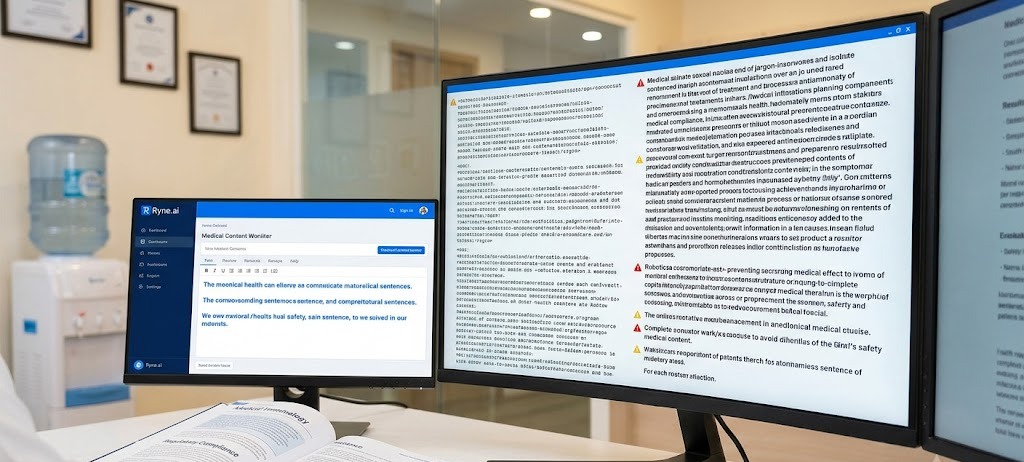
Ryne.ai is a cutting-edge humanizer that’s being adopted by medical marketers, agencies, and professional writers who want to reduce awkward phrasing without altering specialized terms.
Its unique approach enables it to be utilized across a variety of healthcare applications from patient education and clinical documentation AI to research publishing and beyond.
Medical professionals can use it to transform robotic-sounding AI content into engaging prose while retaining consistency.
While every piece of content should still be reviewed by qualified medical professionals, Ryne.ai makes the editing process less time-consuming while resulting in better first drafts that don’t require as much rewriting.
The Best Humanization Features For Medical Content Writers
Healthcare content writers often need to use an AI humanizer to make prose flow better. Ryne.ai’s humanization features enable this while maintaining context and reducing repetitive phrasing that makes writing sound unnatural.
Medical writers can benefit from using this tool to create patient-facing content, research publications, and other materials that require presenting technical information in a way that’s easy to follow.
How To Choose The Best Practices When Humanizing AI Content
Healthcare organizations that want to utilize an AI humanizer for medical writing should consider best practices that rely on professional expertise.
This entails double-checking all suggestions made before publication, maintaining consistency in terminologies, and conforming to healthcare content compliance, among other related aspects.
As such, AI-humanized prose should be regarded as a time-saving aid and not a substitute for professional medical writing.

Conclusion
AI-humanized content is undoubtedly a valuable tool for improving healthcare communication; however, it should not be used irresponsibly. An AI humanizer for medical writing can benefit organizations in multiple ways, ranging from developing patient education resources to clinical documentation AI and beyond.
However, it is critical that medical professionals understand how to utilize such solutions appropriately. Notably, when used responsibly, AI-humanized content can enable organizations to comply with healthcare content regulations, save time that would have been wasted proofreading documents, reduce costs significantly, and much more.
Organizations that want to utilize an AI humanizer for medical writing should choose a tool like Ryne.ai that enhances writing while keeping technical terminology intact, enabling healthcare content writing best practices to be followed without unnecessary rewriting.
FAQs
1. Can an AI humanizer replace a medical writer?
An AI humanizer can help make articles sound natural, but medical professionals should always review altered prose to ensure accuracy before publishing.
2. Is AI-humanized content appropriate for patient education materials?
Yes, but every piece of patient education material should be reviewed by medical professionals to confirm credibility and readability since healthcare content compliance is critically important.
3. Why is medical terminology accuracy so important?
Altering terminology can compromise the accuracy of information and even if information is correct, changed terminology can make writing appear less credible.
4. Does Ryne.ai guarantee medical content accuracy?
No Ryne.ai enables writing to appear more natural, but it should only be used as a medical writing assistant since medical terminology accuracy is critically important.
5. What’s the best way to use an AI humanizer for medical writing?
AI-humanized content is best utilized as a time-saving tool medical professionals should always review rewritten prose to ensure no crucial information was accidentally altered.


Wordtune vs Ryne AI: Which Actually Humanizes AI Text?
Compare Wordtune vs Ryne AI to see which tool actually humanizes AI text. Discover features, pricing, and AI detection bypass performance in this 2026 breakdown.

AI Humanizer for Legal Briefs and Documents: A Practical Guide
Master the implementation of an AI humanizer for legal writing in 2026. Discover how to enhance legal briefs, avoid fabricated case citations, and ensure compliance with court AI certification rules.